Showing posts with label Travel and accommodation. Show all posts
| 1 comments ]

1. Booking travel and holidays
Here are some choices you may make when booking travel/holidays:
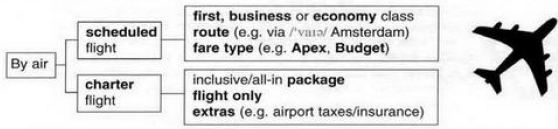


_ A scheduled flight is a normal, regular flight.
_ A charter flight is a special flight taking a group of people, usually to the same holiday destination.
_ Apex fares normally have to be booked a fixed number of days in advance and they offer value for money.
_ Budget fares are usually cheaper but may have restrictions (e.g. you can only travel on certain days) and are usually non-refundable or if you cancel, you may have to pay a cancellation fee.
_ Some tickets allow a stopover (you may stay somewhere overnight before continuing to your destination).
_ All-in packages normally include accommodation and transfers (e.g. a bus or coach to and from your hotel).

_ Sea travel is normally on a ferry, and the journey is called a crossing but you can have a holiday on the sea if you go on a cruise.
_ For some people a luxury cruise is the holiday of a lifetime (one you will always remember)
_ You may decide to book a berth in a shared cabin (a bed in a cabin with other people), or to have a single or double cabin.
_ For more money, you can often get a deluxe cabin, perhaps on the upper deck (the higher part of the ship, which is often bigger and more comfortable).
_ Cruises often go to exotic (unusual or exciting) islans where you can get away from it all (escape your daily life and routines)

_ Car hire is another way of getting around (informal: travelling to different places).
_ When you book it, you normally choose whether you want unlimited mileage (you can travel as many miles as you like for the same price).
_ There may also be extras to pay such as accident insurance.
_ If you hire a car it gives you the freedom to go as you please.

2. Accommodation
_ Some people prefer hotels. Others prefer self-catering (where you do your own cooking) accommodation,such as a holiday apartment or chalet (small cottage or cabin specially built for holiday-makers).
_ In Britain and Ireland, guest houses (private homes offering high standard accommodation; usually beautiful old building) offer good accommodation which is often cheaper than hotels, and there are many private homes offering bed-and-breakfast (often callled B and B).
_ Some types of accommodation offer half board (usually breakfast and one other meal) or full board (all meals)

_ It was a regular flight which the airline runs every day. (a scheduled flight)
_ I hate those special flights where everyone is booked to the same holiday destination. (a charter flight)
_ It was a ticket you had to book 30 days in advance to get the cheaper fare. (an Apex ticket)
_ The ticket allowed us to spend up to three nights in Singapore on the journey from London to Sydney. (a three-night stopover in Singapore)
_ You can get a bed on the ferry in a little room with three other beds. (a shared cabin)
_ We hired a car, with as many miles as we wanted free. (a car with unlimited mileage)
_ When you get there, the bus or taxi to your hotel is included in the cost of the holiday. (the transfers are included in the cost of holiday)
_ It was a special cheap fare, but there were some things you were not allowed to do. (it was a budget fare, but therer were restrictions)

Give expression to explain more than one type of holiday:
1. self-catering holiday: to be your own boss
2. camping trip: to rough it (i.e. to live in very basic conditions, without any extra comforts), to be out in the wilds (i.e. away from civilisation), to sleep under the starts (i.e. out in the open, without a roof over your head)
3. staying in an inn or a guest house; a cosy atmosphere (adj- ấm cúng, dễ chịu).
4. skiing holiday: an exhilarating experience, perhaps also a real learning experience.
5. cruise: to lounge around (sit or lie and relax for long periods), to just drift along.
6. sightseeing holiday: to spend a fortune on entrance fees, a real learning experience.
7. holiday with car hire: to go as you please, to just drift along, to keep on the move.


Read More ...
| 0 comments ]

1. Departures
This is the usual (adj- thông thường) sequence of activites when you get to the airport.

First you go to the check-in desk where they weigh your luggage. Usually you are permitted 20 kilos, but if your bags weigh more, you may have to pay excess (n- vượt quá) baggage (= you pay extra).
The airline representative checks your ticket and gives you a boarding card for the plane with your seat number on it.
Then you go through passport control where an official checks your passport, and into the departure lounge. Here, you can also buy things in the duty-free, e.g. perfume, alcohol and cigarettes.
About half an hour or forty minutes before take-off, you are told to go to a gate number, e.g. gate 14, where you wait before you get on the plane.
When you board (=get on) the plane, you find your seat. If you have hand luggage, you can put it under your seat or in overhead locker above your seat.
The plane then taxis (= moves slowly) towards the runway, and when it has permission to take off, it accelerates along the runway and takes off.

2. The flight
You may want or need to understand certain announcements; these come from the captain (= the pilot) or from an air steward or stewardess/ cabin crew/ fight attendants (= people who look after the passengers):

_ Please fasten your seat belt and put your seat in the upright position.
_ We are now crusing (= flying comfortably) at an altitude (= height) of 10,000 metres.
_ May we remind passengers (= ask passengers to remember) that there is no smoking until you are inside the terminal building (= where passengers arrive and depart).
_ The cabin crew (= air stewards) are now coming round with landing cards. (These are cards you sometimes have to fil in when you enter certain countries.)

3. Arrival
When the plane lands (= arrives on the ground), you have to wait for it to stop/ come to a halt.
When the doors are open, you get off the plane and walk through the terminal building and go to the baggage reclaim where you collect your luggage.
You then pass through customs (green = nothing to declare; red = goods to declare; blue = European Union citizens).
If you are lucky, you can then get a bus, taxi or train to the center of town without waiting too long. You can also hire a car (= rent a car) at most airports.

What do you call:
The place where you go when you arrive at the airport with your luggage?
The card they give you with the seat number on it?
The money you have to pay if your luggage is very heavy?
The place where you sit and have a drink when you are waiting for your flight to be called?
The bags you carry onto the plane with you?
The place above your head where you can put your hand luggage?
The part of the airport when the plane accelerates (v- tăng tốc) and takes off?
The people who look after you on the plane?
The part of the airport you walk through when you arrive or depart?
The place where you collect your luggage after you land?


Read More ...
| 0 comments ]

1. Types of transport:
train
(aero) plane
car
bus
bicycle/bike
taxi
motorbike/motorcycle
underground
boat
ship
helicopter

Are you flying to France from England?
No, we're going by ferry.
We're going by car/ by train/ by bus.

2. Useful travel words:
map
timetable
customs (n) hải quan
luggage
passport

3. A sightseeing holidays
You may do a bit of sightseeing on holiday, or you may do a lot of sightseeing, but you will probably go to a museum or art gallery, and see or visit some of these things:
temple (n) đền thờ
catsle (n) lâu đài
cathedral (n) nhà thờ lớn, thánh đường
market (n)
fountain (n) đài phun nước
statue (n)
palace (n)
church (n) nhà thờ
museum (n)
art gallery (n)
tourist shop (n)
conerts discos/ night clubs
theatre (n) rạp hát
market (n)
Many people go on a sightseeing tour of a town (usually in a bus); they can also go on a tour of the castle/ the cathedral/ the art gallery, etc. When you are sightseeing, it helps to buy a guidebook and a map of the town you are in.

Things that tourists often do on holiday
_ look round the shops/ have a look round the shops.
_ take photographs
_ spend a lot of/ lots of money
_ buy souvenirs (= typical products from the country)
_ get lost (= lose their way)
_ go out most evening
_ have a good/ great time (= enjoy themselves)

Describing places:
These words are often used when we describe places
_ Bruges is a lovely place (=town) and we found a really nice hotel to stay.
_ The town is full of interesting places (=areas/buildings).
_ Venice is beautiful it's always packed (=very crowded/full) with tourists in the summer.
_ New York is very cosmopolitan. (= full of people from different countries and cultures)
_ Vienna has lots of historical monuments (n- công trình, kiến trúc kỷ niệm).
_ Many beautiful cities have become very touristy. (= a negative word: too much tourism)
_ Sao Paolo is a really lively place (= full of life and activity) and the night-life is fantastic.

I spent the first few days sightseeing - The Eiffel Tower, Notre Dame, and all the usual tourist attractions.
Most places are absolutely packed with tourists.
I decided to have a look round the shops and I bought a few souvernis.
I got lost on my way back to the hotel but it didn't matter because I discovered a really fascinating market with lots of little stalls selling just about everything from apples to antiques.

I'm not working next week. I'm on holiday.
Are you going on holiday this summer?
Note: If you want to ask if it is 'a good idea' to visit a place, you can use worth + -ing
If I go to Scotland, is it worth spending a few days in Glasgow?
_ Yes definitely, And if you want to travel round a bit, it's worth renting a car.

4. Don't forget to take with you ...
your passport (if you are going to another country)
a visa (a special stamp in your passport to go to some countries)
your tickets
some traveller's cheques and currency (money of the country you are going to)
a camera
a phrase book (if it's a different language)
your luggage.
Can I have a single/return ticket to Barcelona please?
I'd like to book/reserve a seat in advance. (đặt chổ trước)
How much is the train/bus/taxi/air) fare?
Was the journey long? (not travel)

By train:
The train arriving at platform 3 is the 16:50 train to Paris.
The Edinburgh train departs/leaves from platform 6.
Is there a buffet/restaurant car on this train?
Do I have to change trains for Toulouse?
(= get off one train and go onto another)

By plane:
You have to check in an hour before the plane takes off.
(= leaves the ground)
I went through customs but nobody checked my passport.
Give your boarding card to the flight stewards when you get on the plane.
Have a good flight.
The plane landed in New York at 5:30.

By car:
We hired a car for a week. We had to fill it up with petrol.
Can I give you a lift? I'm going into town.
land - planes do this at airports.
fare - what you must pay when you travel.
buffet car - a place to eat on a train
ship - it travels on water e.g. the Titanic
timetable - it says when trains depart and arrive
platform - where you stand when you are waiting for a train.
luggage - bags and suitcases.

5. When you are there ...
Send some postcards.
Try the local food.
Enjoy the nightlife. (discos, clubs, ect ....)
Try to speack the language.
Go to the Tourist Information Office if you have any questions.

What type of holiday did they have?
_ Everythings was included, meals, hotels, flights.
_ We were on the same coach for seven days. I was very tired.
_ We walked about 20 kilometres every day.
_ It wasn't very good. There wasn't much snow.
What is the diference between a single ticket and a return ticket?
_ A single takes you to a place and a return takes you to that place and back again.
What does a customs officer do?
_ He or she checks what people bring into a country.
Does a plane take off at the end of a journey?
_ No, it lands at the end of a journey and takes off at the beginning of a journey.
What do you do with a boarding car?
_ You can get on a plane or a boat.
What is the difference between hiring a car and buying a car?
_ If you hire a car you have it for a day or a week. If you buy it it is your car.
If you ask someone for a lift, do you want to go to the top floor?
_ No, you want to go somewhere in their car.

Here are instructions to get to John's house from the airport.
When you arrive at the airport, follow the signs to the stop bus, take a number 10 bus to the railway station. There are trains every hour. Buy a ticket to Bigtown, then take a train to Bigtown. The journey takes half an hour and you get off the train at the second stop. Take a taxi from the station to John's house. John's house is on the corner of the New street with a red door.

Read More ...

About