
A. Match each newspaper headline in the box with the first line of its accompanying story
below. Use the underlined words and expressions to help you.
A. ILLEGAL ALIENS TO BE EXPELLED
B. ETHNIC MINORITIES ‘LIVING BELOW POVERTY LEVEL’
C. HOMELESS SQUATTERS EVICTED
D. INSTITUTIONAL RACISM STILL A PROBLEM
E. INTERNALLY DISPLACED IN NEW GENOCIDE HORROR
F. EXTREMISTS ACCUSED OF INCITING RACIAL HATRED
G. UNREST, RIOTS AND ANARCHY CONTINUE
H. REBELS VICTORIOUS IN LATEST POWER STRUGGLE
I. DISCRIMINATION AND EXPLOITATION A MAJOR PROBLEM IN BRITISH INDUSTRY
J. DISSIDENTS ASK AUSTRALIAN GOVERNMENT FOR POLITICAL ASYLUM
1. Officers from the Thames Valley Police Force raided a house in Kidlington earlier this morning and forcibly removed a family who had been staying there illegally since they lost their home in August.
2. Almost 50% of factory workers in national companies claim they have received bad treatment or have been taken advantage of because of their class, religion, race , language, colour or sex, it has been revealed.
3. The UN has accused the government of Zarislavia of further atrocities committed in the west of the
country, where hundreds of migrants are reported to have been killed by security forces.
4. Opponents of the government in Yugaria have asked to stay in Sydney because the political situation in their own country is making it unsafe for them to return.
5. The police have once again been accused of discriminating against minority groups, despite their
reassurances earlier this year that they had reformed their practices.
6. Neo-Nazi groups in Paris were today condemned for inciting violence against non-whites in the centre of the city.
7. A shocking survey has revealed that almost 30% of Asian and African racial groups living in London are suffering financial hardship.
8. Following further devaluation of the Malovian dollar, violence has once again erupted on the streets of the capital.
9. Groups fighting against the government of George Malikes in Livatia have succeeded in capturing and occupying the parliament building.
10. The Government has ordered the immediate deportation of over 200 immigrants who entered the
country without passports or visas last year.
B. Match the words and expressions in the first box with a word or expression in the second
box which is either the closest in meaning or which is normally associated with it. Some of
these also appear in Task A.
ethnic cleansing • prejudice • civil rights • harassment
rebel • picket line • poverty-stricken • refugee • outcast
reject (noun) • non-conformist • blackleg • human rights • destitute
discrimination • displaced person • intimidation • racial purging
C. Now look at this news programme and complete the gaps with one of the words or
expressions from Tasks A and B. In some cases, more than one answer may be possible. You
may need to change the form of some of the words.
Good evening. Here is the news.
Neo-Nazis and other 1__________________________ have been held responsible for a wave of
2__________________________ in the Bratilovan Republic. The United Nations estimates that over 20,000
people have been murdered there in the last six months. 3__________________________ who have escaped
from the country have asked the British government to grant them 4__________________________ , as they
fear for their safety if they have to return.
The government are to deport 500 5__________________________ whose visas have expired. Angry
members of the opposition have accused the government of 6__________________________ , as most
of the deportees are of African origin. Meanwhile, the police have been accused of
7__________________________ , after Asian families in Bradford complained they had been pestered and
worried by officers following a series of robberies in the city.
8__________________________ leaders in the USA have held a demonstration in Washington against the
death penalty. They have called for a total abolition of capital punishment, claiming that it is contrary to
basic 9__________________________ principles outlined in the United Nations Declaration of Human Rights.
10__________________________ fighting the government of President Stanislow have taken control of the
television station in the centre of the capital. This follows a long-standing 11_________________________ .
between Mr Stanislow and the principal opposition party which has seriously weakened his power.
A spokesman for the 12__________________________ community in London has presented a petition to the
government asking them to provide housing for everyone. He argues that the government’s refusal to
raise the minimum wage rate has resulted in thousands living in 13__________________________ , with not
enough money to pay for somewhere to live. Meanwhile, the Metropolitan Police evicted several
14__________________________ who took over a house in the city centre last week and refused to leave
until the government took positive action.
A recent survey reveals that at least 30% of public companies have been accused of
15__________________________ and 16__________________________ in the past year. The main offender is
Anglo-Amalgamated Telecommunications, a Bristol-based company. Their employees, many of them
Asian women, claim they have received bad treatment or been taken advantage of by the company.
And finally, the Cardiff police are preparing for angry scenes at the Welsh International Computers factory
tomorrow when 17__________________________ , anxious to return to work after six months on strike, will
attempt to break through the picket line. A senior officer has expressed his concern that there will be
18__________________________ and people will get hurt as a result.
Answers:
A.
A. 10 B. 7 C. 1 D. 5 E. 3 F. 6 G. 8 H. 9 I. 2 J. 4
B.
ethnic cleansing - racial purging prejudice - discrimination civil rights - human rights harassment - intimidation
rebel - non-conformist (the opposite of this is a conformist) picket line - blackleg poverty-stricken - destitute
refugee - displaced person outcast - reject
C.
1. extremists 2. ethnic cleansing / genocide 3. Dissidents / Refugees 4. (political) asylum 5. illegal aliens
6. (institutional) racism 7. harassment / intimidation 8. Civil rights / Human rights 9. human rights / civil rights
10. Rebels 11. power struggle 12. homeless 13. poverty 14. squatters 15 / 16. discrimination / exploitation
(in either order) 17. blacklegs 18. riots / unrest
Other words and expressions which you might find useful include:
discrimination / sectarian / multi-racial / multi-cultural / unorthodox / disparate / itinerant / community

A. Complete these sentences with an appropriate word or expression from A, B or C.
1. Mr and Mrs Smith live at home with their two children. They are a typical example of a modern
______ family
A. extended B. nuclear C. compact
2. Mr and Mrs Popatlal live at home with their aged (adj-cao tuổi, có tuổi) parents, children and grandchildren. They are a typical example of a traditional _________ family
A. nuclear B. enlarged C. extended
Questions:
3. Mrs Jones lives on her own and has to look after her two children. There are a lot of
________ families like hers
A. single-parent B. mother-only C. mono-parent
4. Some parents need to _______ their children more strictly
A. bring down B. bring about C. bring up (v-nuôi nấng)
5. When I was a child, I had a very turbulent _________
A. upbringing (sự dạy dỗ) B. upraising C. uplifting
6. Mrs Kelly is _________ and finds it difficult to look after her children on her own
A. divorced B. divided C. diverged
7. Many men believe that ________ is the responsibility of a woman
A. childhelp B. childcare C. childaid
8. _______ is a particularly difficult time of life for a child
A. convalescence B. adolescence (thời thanh niên) C. convergence
9. A person’s behaviour can sometimes be traced back to his/her _________ (v-truy về)
A. creative years B. formulating years C. formative (adj-hình thành) years
10. The country has seen a sharp drop in the ________ in the last few years
A. birth rate (tỉ lệ sinh) B. baby rate C. born rate
11. She has five _________ who rely on her to look after them
A. dependants (noun) B. dependers C. dependents (adj)
12. ________ is on the rise, with over 20% of serious crimes being committed by children
under the age of seventeen
A. junior crime B. juvenile delinquency (phạm pháp vị thành niên) C. minor crime
B. Match sentences 1-12 with a second sentence A-M. Use the key words and expressions in bold
to help you.
1. Mr and Mrs White are very authoritarian (adj-độc tài) parents.
2. Mr. Bowles is considered to be too lenient. (adj-hiền, nhân hậu)
3. Mr and Mrs Harris lead separate lives.
4. Billy is a well-adjusted kid.
5. The Mannings are not very responsible parents.
6. My parents are separated. (adj-ly thân)
7. Parents must look after their children, but they shouldn’t be over-protective. (adj--che chở ko hợp lý)
8. Professor Maynard has made a study of the cognitive processes of young children.
9. I’m afraid my youngest child is running wild.
10. She looks quite different from all her siblings.
11. There are several different and distinct (adj-khác biệt, riêng biệt) stages of development in a child’s life.
12. Tony was raised by (v-nuôi dưỡng bởi) a foster family when his own parents died.
A. They don’t look after their children very well.
B. He is fascinated by the way they learn new things. (v-mê hoặc, quyến rũ)
C. He very rarely punishes his children.
D. I live with my mother and visit my father at weekends.
E. He never listens to a word I say, and is always playing truant (to play truant v- trốn học) from school.
F. Brothers and sisters usually bear some resemblance to one another. (to bear a resemblance to v- giống với)
G. Although they are married and live together, they rarely speak to each other.
H. They are very strict with their children. (adj-nghiêm khắt, khắt khe)
I. Of all of these, the teenage years are the most difficult.
J. Children need the freedom to get out (v- đi ra ngoài) and experience the world around them.
K. He’s happy at home and is doing well at school.
L. My families take in children who are not their own.
C. Now read this case study and fill in the gaps with one of the words or expressions from
Tasks A and B. In some cases, more than one answer may be possible. You may need to change
some of the word forms.
Bob’s problems began during his 1_______ years. His parents got
2________ when he was young, and neither of them wanted to raise him or his brother
and sister, so he was 3__________ by a 4________ chosen by his parents’
social worker. Unfortunately, his foster-father was a strict 5________ and often beat him.
Bob rebelled against this strict 6_________ , and by the time he was eight, he was already
7_________ , stealing from shops and playing truant. By the time he reached
8_________ , sometime around his thirteenth birthday, he had already appeared in court
several times, charged with 9_________ . The judge blamed his foster parents, explaining
that children needed 10_________ parents and guardians who would look after them
properly. The foster father objected to this, pointing out that Bob’s 11________ - his two
brothers and sister - were 12________ children who behaved at home and worked well at
school.
This has raised some interesting questions about the modern family system. While it is true that parents should not be too 13__________ with children by letting them do what they want when they
want, or be too 14__________ by sheltering (v-che chở, nương nấu) them from the realities of life, it is also true that they should not be too strict. It has also highlighted the disadvantages of the modern
15__________ family where the child has only its mother and father to rely on (or the
16__________ family, in which the mother or father has to struggle particularly hard to support their 17___________ ). In fact, many believe that we should return to traditional family values and the 18__________ family: extensive research has shown that children from these families are generally better behaved and have a better chance of success in later life.
Answers:
A.
1. nuclear 2. extended 3. single-parent 4. bring up (we can also use the words raise or rear)
5. upbringing
6. divorced 7. childcare 8. adolescence (the noun is adolescent) 9. formative 10. birth rate
11. dependant (the adjective is dependant)
12. juvenile delinquency (in Britain, a juvenile is anybody below the age of 18, which is the
age at which somebody becomes legally responsible for their own actions)
B.
1. H (authoritarian can be a noun and an adjective) 2. C 3. G 4. K 5. A 6. D 7. J (we can also use the expression over-caring) 8. B 9. E 10. F 11. I 12. L
C.
1. formative (adj-hình thành) 2. divorced 3. brought up 4. foster family (a child who is raised by a foster family is called a foster child. The verb is to foster (v-nuôi dưỡng)) 5. authoritarian
6. upbringing 7. running wild
8. adolescence
9. juvenile delinquency 10. responsible 11. siblings 12. well-adjusted
13. lenient 14. over-protective
15. nuclear 16. single-parent 17. dependants 18. extended
Other words and expressions which you might find useful include:
abuse / rebelliousness / relationship / supervision / minor / relatives / nurture / kin / family life / split up / broken home/ divorce rate
More informations:
Read the following eight examples of bad behavior in children listed below. Discuss the best and worst ways for parents to react to each of these behaviors. The "best way" means away that is likely to teach good behavior to the child. The "worst way" is a way that will probably not be successful in teaching good behavior: Make brief notes about your ideas.
1. Sarah, a 2 year old, keeps throwing her food on the floor and cries untill her parents pick it up.
2. David, a 5 year old, is angry and frustrated. He hits his baby sister.
3. Ronnie, a 6 year old, runs up and down the aisles when his parents take him to the supermarket and screams when they tell him to stop.
4. Sheila, an 11 year old, is caught copying a classmate's test.
5. Stephen, 12 year old, takes money from his father's wallet.
6. Tim, a 13 year old, begins to smoke cigarettes.
7. Erica, a 15 year old, refuses to go to bed until 2 a.m
8. Freddie, a 17 year old, comes home really late and won't explain to his parents where he has been.
Lecture: Family Lessons
1. I'd like to focus on three of the way that children acquire their behavior.
2. A reward can be defined as a positive reinforcement for good behavior.
3. Most parents use rewards unconsciously.
4. Punishments are the second important way in which a child is socialized
5. Both rewards and punishments are controversial. Many people think that they are not effective.
6. Some people argue that the reward is unneccessary because it is like a bribe.
7. The child should be taught that it's his duty to help with household chores.
8. Some of us grew up expecting to be spanked if we misbehaved.
9. Our parents may have hit us on hand if we talked back to them.
10. Some children are subject to really serious physical abuse.
1. Children's first role models are their parents.
2. There is an old saying in English: Don't do as I do. Do as I tell you." ... But this advice doesn't work most of the time.
3. If you smoke yourself, it is probably ineffective to tell child not to smoke.
4. Many people do not even realize the impact that they can have on a child.
5. It is common for babysitters, relatives, and child-care centers to take care of children.
6. The most important thing for children is to grow up in an environment where there are fair rules that are clearly established and followed consistently by everyone.
Consider these case studies:
Basically, the foods I was eating were contributing to my disorder. She gave me a list of foods that would provide the right 13_______ and 14_______ to keep me in good health. At the same time, she recommended a more 15______ lifestyle - running, swimming, that kind of thing. I’m a bit of a couch potato, and the 16______ lifestyle I had lived was compounding the problem. Now I feel great!” So is there still a place in our lives for modern medicine? While it is true that some infections and viruses may be prevented by resorting to alternative medicine, more serious illnesses such as 17______ need more drastic (adj-mạnh mẽ, quyết liệt) measures. We do need our health service at these times, and we shouldn’t stop investing in its future. But we mustn’t forget that for some common illnesses, the cure may lie in the past.
2. a diet (this refers to the food we eat. If you go on a diet, you eat less in order to lose weight)
4. traditional medicines
5. holistic medicine (an example of this is aromatherapy)
6. consultant
7. surgeon (surgery is the treatment of disease which requires an operation to cut into or remove part of the body. Do not confuse this with a surgery, which is a room where a normal doctor, sometimes called a family doctor or general practitioner - a GP - sees their patients)
8. protein
9. vitamins
10. minerals
11. active (the opposite of this is sedentary - see Task 1)
12. welfare state (other features of a welfare state include providing citizens with adequate housing, education and public transport)
1. Techical advances affecting daily life

_ My younger brother's a real computer nerd. He never goes out, and all he ever thingks about is computers, computers, computers.
_ I'm a bit of a techie really; I love getting the lastest mobile phone or the newest digital camera.
_ Anologue videl camera cannot match the versatility and quality of digital cameras.
_ He has a really cool screensaver which is a picture of planets, comets, stars and things all rushing towards you.
_ This new printer's got a smaller footprint than the one I had before, which is good, since my desk is not very big.
_ Just click on that icon there to open the program.
_ I don't really like this trackpad on my laptop; I'd prefer a proper mouse.
1. Gathering the news
_ Journalist gather news in a number of different ways. They may get stories from pressure groups (1) which want to air their views (2) in public.
_ They seek publcity (3) for their opinion and may hold press conferences (4) or may issue a statement/ press release (5). A person who especially wished to attract news attention will try to include a sound bite (6) in what they say.
_ It is particularly hard for journalists to get material in the silly season (7).
_ Journalists also get stories by tapping useful sources (8) and by monitoring (9) international news agencies like Reuters.
_ The more important a story is, the more column inches (10) it will be given in the newspaper.
_ Journalists of different political persuations often put their own gloss/spin on a story (11) and some journalists gather stories by muck-rating (12).
(1) people trying to influence what other people think about a particular issue.
(2) express their opinions
(3) want to reach a wider audience
(4) meetings to give information to and answer questions from the press
(5) give a formal announcement to the press
(6) short memorable sentence or phrase that will be repeater in news bulletins and articles
(7) time of year, summer in the UK, when there is not much happening and trivial stories end up on the front page.
(8) making use of people or organisations which regularly provide news
(9) regularly checking
(10) space
(11) present a story in a particular way
(12) collecting scandal (informal and disapproving)
2. Delivering the news
_ Arag is an informal word for a newspaper and it suggests that it is not of very high quality. The gutter press is a disapproving term used about the kind of newspapers and magazines that are more interested in crime and sex than serious news.
_ A glossy is an expensive magazine printed on good quality paper.
_ Journalists produce copy. which has to be ready for a deadline. When everything is ready the newspaper goes to press. A very important story that comes in after going to press may find its way into a stop press column.
_ A very new newspaper or story can be said to be hot off the press.
_ A story that is only to be found in one newspaper is an exclusive.
_ A scoop is a story discovered and published by one newspaper before all the others.
_ A major story can be said to hit the headlines on the day it is published. At that time the story breaks or becomes public knowledge. If it is an important story it will receive a lot of coverage or space in the press.
_ A newspaper may be taken to court for libel or defamation of character if it publishes an untrue story that harms a person's reputation.
_ If you are doing research into a news event, you may want to get hold of some previous issues of newspapers, or back copies, and you may wish to make a folder of cutting from the papers about the event.
Exercise (refer to documents)
1. The pros and cons of Internet use
Here is a list of some possible advantages (pros) and disadvantages (cons) of the Internet.

(1) a kind of e-mail where both people are online at the same time.
(2) an onlive conversation between a group of people on topics chosen by them, where you can enter or leave the 'room' at any time.
(3) a website where people with shared interests can get news and information.
(4) all kinds of business done on the Internet
(5) files you send at the same time as e-mail messages
(6) looking at diferent websites, with no particular goal.
(7) moving from one website or one web page to another, usually looking for something
(8) technical term for pictures, icon, diagrams, etc.
(9) ISP-Internet Service Provider: a company that offers user access to the Internet and services such as news, e-mail, shopping site, etc., usually for a monthly fee.
(10) bringing files to your computer from the Internet
(11) sending files from your computer to the Internet or to another Internet user.
(12) unwanted advertisements and other material sent to you by e-mail from companies
(13) a kind of program that is sent from the Internet to your computer, often without your knowledge, which can follow and record what you do, which websites you visit, etc.
(14) material such as pornography, or extreme political views, or material that encourages hate and violence against people.
2. E-mail and Internet communications
_ I've bookmarked the CNN home page as I use it regularly to get the lastest news. (put it in a list of websites I can access immediately)
_ If you subscribe to newsgroups, you often get hundreds of messages. (become a member of)
_ Some ISPs allow you to screen out unwanted mail. (prevent from reaching you)
_ Our server (distributes e-mail and other services to users) at work was down (not working) yesterday so I didn't get your message till today.
_ Someone hacked into our company server and destroyed all our files. (accessed it is illegally)
_ Do you have good anti-virus software? It's worth updating it frequently. (protection against computer viruses)
_ She must have changed her email address - the email I sent her bounced. (came back to me)
_ That file you sent me as an attachment was unreadable. The text was completely garbled. (just a series of meaningless letters and numbers)
_ I sent a photo of my house by e-mail to my friend in Canada, but it took ages to upload (transfer from here to there) and I spent 20 minutes online. (connected to the Internet)
_ I've had your message in my inbox (a place where unread e-mail are stored) for two days but haven't had time to read it yet.
_ I had a lot of trouble trying to install (add to the programs already on my computer) that new software I bought.
_ How do I undelete (retore something accidentally rubbed out) on this computer?
_ I write my e-mails offline (while disconnected from the Internet) and then connect to send them.
_ A new law has given e-signatures the same legal status as handwritten ones. (E-signatures are a way of identifying yourself on the Internet with a unique code or name, which you could use, for exmaple, to agree to pay for goods)
_ E-learning will become more and more common as an alternative to traditional learning. (E-learning means talking courses over the Internet instead of going to a school or college to do your studies)
_ We have e-enabled everything you need to study on the Internet (E-enabled here means that all the study materials can be accessed and worked with throuhg the Internet)
_ E-books are beginning to seriously compete with traditonal books. (read on your computer or your hand-held PDA-Personal digital assistant)
_ The dotcom economy has attracted hunrdreds of new businesses hoping to make a fortune. (The doccom economy refers to Internet companies) Read More ...
1. Typical sections found in newspapers and magazines
_ One thing I always read in the papers is the obituaries (1); it's so interesting to read about the lives of well-known people. I also usually read the leader (2) (or editorial); it helps me form my opinion on things.
_ Although natiomal newspapers give you all the important news, I find that if you just want to sell your car or something, the classified ads (3) in a local paper is the best place. But at the weekend I just love the Sunday papers.
_ Most British Sunday papers have supplements (4) with articles on travel, food and fashion and so on, and that keeps me occupied for hours.
_ Last week there was a feature (5) on new technology in one of them; it was fascinating. My teenage daughter prefers magazines, especially the agony columns (6).
_ I just can't imagine writing to an agony aunt (7). It amazes me how people are prepared to discuss their most intimate problems publicly.
(1) descriptions of the lives of famous people who have just died.
(2) an article giving the newspaper editor's opinion
(3) pages of advertisement in different categories
(4) separate magazines included with the newspaper
(5) an article or set of articles devoted to a particular topic
(6) sections in a paper or manazine that deal with reader's private emotional problems
(7) person, typically a woman, who answers letter in the agony column.
2. Some types of printed material

pamphlet (n)
leaflet (n)
brochure (n)
prospectus (n)
flyer (n)
booklet (n)
manual (n)
_ The small advertisement in different categories found in newspapers (classified ads or advertisements)
_ A person you write to at a magazine to discuss intimate emotional problems.
_ The section of a newspaper which has tributes to people who have just died.
_ An article in a newspaper which gives the editor's opinion.
_ A separate magazine that comes free with a newspaper.
_ An article or set of articles devoted to a special theme.
_ I've decided to do my own car maintenance, so I've bought the manual for my particular model.
_ Someone was giving out flyers/leaflets in the town centre today about a demonstration that's going to take place on Saturday.
_ I love looking through holiday brochures and dreaming about flying off to exotic (adj- đẹp kỳ lạ) places.
_ I never read political pamphlets; they're so boring.
_ This leaflet gives the opening times for the art gallery.
_ I've got this really useful booklet with details of all the local sights.
_ I've read the prospectus and I like that university; I think I'll apply. Read More ...
1. Cash, cheques and cards
_ I was broke/skint at the end of last month. (had no money left; broke = informal; skint = very informal)
_ I'm rolling in it this month; I got a cheques for $3,000 for some work I did. (informal: have a lot of money)
_ It's diffocult to make ends meet sometimes with three children and only one parent working. (to survive financially)
_ Things are a bit tight at the moment. (informal: my finances are not good)
_ I was strapped for cash and had to borrow money from my parents. (informal: needed cash and had very little)
_ She gave me a cheque for what she owed me but it bounced. (the bank refused to pay it)
_ Who shall I make this cheque out to? (What name shall I put on it?)
_ Shall we put/stick this meal on my credit card? Then we can forget it. (informal)
_ Could you charge it to my credit card please? (formal)
_ The APR for this credit card is 23%, that's two per cent lower than my other card. (annual percentage rate of interest)
_ My card expires 05/04. (is not valid after)
_ Credit card fraud has increased in recent years. (illegal use of someone's card or account)
2. Saving, pensions, etc
The words in bold in these newsclips refer to longer-term aspect of personal finances.
_ Victims (n- nạn nhân) of last year's rail crash will receive lump sum (1) compensation (n- sự bồi thường) payments following a High Court decision today.
_ A golden handshake (2) of one milion pounds was paid to the boss of one of Britain's biggest companies today.
_ Mr Carslow had taken out an endowment (3) ten years earlier to pay for his son's education.
_ The thieves stole Mr and Mrs Freal's life-saving (4), which they kept under their bed in a metal box.
_ People will well-managed share portfolios (5) have done better than individuals who buy stocks and share privately.
(1) single, large payment
(2) large payment to someone on leaving a job
(3) combined insurance and savings plan that pays out after a fixed period.
(4) money saved over many years
(5) combination of stocks and shares of different kinds
Exercise:
_ This is a credit card. If you want one that you have to pay off each month, then you should get yourself a charge card.
_ She never used her card on 4th September. But someone did and bought hundreds of pounds of goods. It was a case of credit card fraud (n- gian lận)
_ I haven't got enough cash to pay for this meal, but they take credit cards; shall I just put/stick it on my credit card?
_ You'll take a cheque, will you? Good, Who should I make it out to?
_ He wrote me a cheque, but he had no money in his account so it bounced (v- đánh lừa).
_ I'm sorry, I can't lend you anything at all. I'm absolutely broke/skint.
_ I couldn't really afford it as I was a bit strapped for cash.
_ I have to be very careful how I spend my money; right now things are a bit tight.
_ The amount you pay each month or year for an insurance policy. (premium n- phi bao hiem)
_ A person who lends money at extremely high interest rates to people in financial difficulty. (loan shark)
_ Money you borrow to buy a house or flat. (mortgage)
_ Money you have to pay up to a certain level if you make an insurance claim. (excess)
_ Insurance you pay against illness. (health cover)
_ A scheme to provide you with an income when you retire. (pension plan)
1. International aid, debt and development
In a public question and answer session on the Internet in 1999, Clare Short, the Minister responsible for Britain's international development policies and activities, gave this answer to question from someone in Haraze, Zimbabwe.
Question: Are the UK and Europe tired of trying to encourage real and lasting deveplopment projects in Africa?
Answer:
_ It may surprise you to learn that there are many encouraging signs in Africa. Over the last three years, 31 Afrucan countries achieved economic growth of more than 3% per year.
_ Foreign direct investment, although still too small, has been rising. Africa's share in world trade has shown signs of recovering from its long decline. Some countries, such as Maxambique ..., have done much better than this.
_ But some 250 million people in Africa still live in deep poverty and we must do better. With other development agencies we are committed to supporting those African government which are following policies to reduce poverty and improve access to better health, education and clean water.
abject poverty is also a typical collocation
development grants are often given to poor regions. (money to help economic development)
sustainable development is the most important goal for most countries (development that does not destroy the economy/ the environment, etc)
2. Trade and cooperation
_ Free trade agreements often cause disputes between countries, especially when one country thinks the other is engaged in restrictive practice (1).
_ Occasionally, trade wars erupt, and sanctions (2) or embargoes (3) are imposed on countries, and may not be lifted for long periods.
_ On the other hand European countries closely related economically and enjoying good relations have entered into monetary union and have a single currency.
(1) the placing of unfair restrications, e.g. limiting imports.
(2) restrictions on what a country may import/export.
(3) total prohibition on importing/exporting certain goods.
3. Economic difficuties and negative practices
_ If an economy is badly affected by war, we may refer to it as a war-torn economy.
_ Econmies in a bad state are often referred to as ailing economies.
_ Devaluation/revaluation of the currency may be necessary. (reduction/increase in value against other currencies)
_ Economies may go into recession and not come out of/ emerge from recession for several years. A country may suffer from a slump in prices for its goods.
_ Fiscal measures may be used to boost the economy when it is in recession.
_ Development is important, but it should be sustainable development, not the kind that destroys the environment and social structure.
_ The government is following a policy of giving aid only where it is used to reduce poverty.
_ There have been some encouraging signs that development aid is working in many countries.
_ Millions of people still live in deep poverty.
_ The economy has recovered from its decline and is now doing well.
_ The struggle to achieve economic growth in developing countries is a constant one.
_ It is importance to encourage lasting development projects, not just short-term ones
_ The goal should be to improve access to better health and education for the poor.
_ Over a period of five years, the country incurred (got) huge debts which it could not repay (pay back).
_ Debtor countries (countries in debt) are completely at the mercy of the rich nations.
_ The burden of debt (The weight of debt) is so great in some countries that their economies are collapsing.
_ Rcher countries could do a lot to ease/ alleviate (make) the debt of poor countries and indeed, in some cases, could cancel (or write off) (forget) the debt altogether.
1. Some techinical terms for talking about your language
Syntax: the grammar and word order
_ How does your language express modality? (meanings such as possibility and necessity)
English does it with modal verb like must, could and should.
Phonology: the sound system, i.e. pronunciation and intonation
_ How many vowel phonemes does your language have? (different sounds that distinguish meanings)
English has 12 and 10 diphthongs. (sounds made by combining vowels, such as ei)
Lexicon: technical term for vocabulary
_ The Germanic languages have many compounds (words formed by combining words, e.g. software)
English has a mixture of Graeco-Latin (originally from Greek and Latin) words and Anglo-Saxon words
Orthography: technical term for writing systems
_ The English alphabet has 26 characters (letters or symbols)
Morphology: how words are formed
_ There are three morphemes in unthinkable: un, think and able (units of meaning).
_ The writing system of Burmese is quite difficult for a foreign learner.
_ Japanese uses several different writing systems with hundreds of letters and symbols.
_ The vocabulary of a language like English is constantly changing. A lot of new technical words are based on roots from Latin and Greek, rather than words from the period pre-1000 AD.
_ Unlike English, some world languages have very few vowel sound and not combinations of vowels.
_ This ancient and beautiful alphabet uses symbols that evoke pictures to express meaning.
_ Windscreen is a noun made from two nouns
_ Meanings connected with probability and obligation are expressed in different forms in different languages.
1. Describing festivals
Loot at these short extracts about Chinese cultural festivals.
_ The Taipei Lantern Festival is held at the time of China's traditional Lantern (n- đèn lồng) Festival, which falls two weeks after the Chinese New Year and features children parading about the streets at night carrying homemade lanterns.
_ Lanterns remain the focus of the festival. The most spectacular of all is the theme lantern (n- đèn lồng) at the Chiang Kaishek Memorial Hall.
_ Chinese New Year's Day will normally fall between January 10 and February 19. It is the grandest holiday for all Chinese around the world and is celebrated in many ways during the course of season, depending on your age, sex and marial statuts.
_ It celebrates the birth of a new year, a time for renewed hope.

2. Other useful words and phrases connected with festivals
_ A lot of people are very superstitious (ad- mê tín), especially about numbers and colours. (have illogical (adj- phi lý, ko logic) beliefs about hidden forces in nature)
_ The festival celebrated the centenary/bi-centenary of the country's independence. (100th anniversary/ 200th anniversary)
_ In some cultures, traditional festivals celebreate the end of periods of penance (actions to show you are sorry for bad deeds) and fasting (not eating for a long period).
_ The Rio de janeiro carnival is always a very flamboyant (extremely colourful and exaggerated (ad- sặc sỡ, rực rỡ)) and raucous (very noisy) event.
_ The Festival of the Dead was very sombre (serious, heavy and sad) and atmospheric (had special feeling or atmosphere)
_ The annual holiday commemorates all those who died in the country's civil war. (formal: respects and remembers offically)
Read More ...
1. Entering and leaving: customs
_ On arrival in most countries as a foreigner you have to show your passport, a landing card (1) and often a customs declaration form (2). You may need a visa and a vaccination certificate (3), depending on the entry restrictions (4).
_ Customs carry out spot checks/ random checks (5) on people's luggage. They use sniffer dogs (6) to search for drugs and explosives.
_ In most casess, you have to clear customs (7) at the port of entry. Genuine refugees (n- người tị nạn) may try to seek political asylum (9). Customs officers also look out for illegal immigrants, some of whom may be economic migrants (10)
(1) form with your personal details and date of arrival.
(2) form showing how much money and what goods you are carrying
(3) paper proving you have had the neccessary health injections
(4) rules about who can enter a country and for how long
(5) checks done without warning
(6) specially trained dogs who can smell drugs and bombs
(7) take your bag through customs
(8) the port or airport where you first enter a country
(9) permission to stay in another country to avoid polical persecution back home.
(10) people who try to enter from poorer countries just to get work.
2. Police, traffic wardens, etc.
Look at this extract from an information leaflet (n- tờ truyền đơn) for students coming to study and live in an English spearking country.
Note the collocations
_ For some traffic offences (1) you have to pay a fixed penalty (2), and this may be an on-the-spot fine (3).
_ Parking ticket (4) for illegal parking are issued by police and/or traffic wardens (n- người giám sát).
_ If there has been an accident, the police may ask drivers to take a breathalyser (5) test and to make a statement (6) at a police station.
_ Police have limited stop-and-search (7) powers. Surveillance cameras (8) operate in many public areas.
_ A police officer cannot normally enter your home against your wishes without a search warrant (9).
(1) offence is a formal word for an illegal action.
(2) fixed sum payable for a particular offence
(3) fine payable at the time and place that you commit the offence.
(4) papers placed in driver's widscreens fining them for illegal parking
(5) an instrument which you blow into that show if you have consumed alcohol recently.
(6) say what happened and sign a copy of it.
(7) power to stop people and search them in the street
(8) cameras that record everything that happens
(9) offical permission from a judge or magistrate to search your home.
3. Other types of policing

underconver (adj) kín, giấu giếm, lén lút
pramailitary (adj) bán quận sự
squad (n) nhóm người, tổ, đội
corruption (n) tham nhũng, đồi trụy, mục nát
drug (n) ma túy, chất kích thích
_ You'll have to show a vaccination (tiêm ngừa) certificate for tropical disease when you enter the country. (paper proving that you have had injections)
_ People entering from war-torn countries often seek political asylum. (ask for permission to stay to avoid)
_ You have to clear customs if you arrive on an international flight at San Franciso airport, even if you are flying on within the USA. (take your baggage through customs)
_ You have to fill in a customs declaration (form) before going through customs control. (paper saying how much money you're bringing into the country)
_ Some of the people were economic migrants, rahter than genuine political refugees. (people who were poor and travelling hoping to find jobs)
_ Passenger to airline cabin attendant: Could you give me a landing card before we arrive, please? (one of those papers for filling in my passport number are personal details)
_ At the airport the security guards had sniffer dogs. (thoses special dogs that can smell drugs)
_ You'll need a visa; the entry restrictions are very strict. (rules about who can enter the country)
_ You have to fill in the port of entry in this box here. (city where you first entered the country)
Read More ...
1. Good service
Look at these comments by someone about a company they recently used.
_ They're a good company. They always make sure you get a prompt (quick, without delay) reply to any query (n- chấp vấn, thắc mắc) (question or enquiry about service) and they're very responsive (adj- đáp ứng nhiệt tình, thông cảm) to complaints (they listen, take them seriously and act).
_ When I rang to ask if I could change the delivery date, they were very accommodating (adj- dễ dãi, xuề xòa) (willing to understand and help) and got back to me (called me with an answer to my query) within ten minutes with a new date.
_ Whenever I ring I get impeccable (adj- hoàn hảo, ko chê vào đâu) (100% perfect) service; they're always very helpful and obliging (adj- hay giúp đỡ) (willing and happy to do things for you), whatever the problem is.
2. Bad service

incompetent (adj) thiếu khả năng, thiếu trình độ
impersonal (adj)
shoddy (adj) giả mạo, chất lượng kém
substandard (adj) dưới tiêu chuẩn
uncoocperative (adj) bất hợp tác
_ There's huge backlog of orders and they can't deliver for three weeks. (number which are waiting to be dealt with)
_ They never seem to have any sense of urgency when you ring them. It's exasperating. (feeling that your request is important or urgent)
_ They have a helpline (telephone number where you can get help if you have problems), but it's useless (adj- vô ích, vô dụng); they always put you on hold (make you wait) every time you ring.
_ My TV broke down but it was still under guarantee/ warranty so I didn't have to pay to get it repaired. (having a written promise by a company to repair or replace a faulty product).
3. Service encounters on the Internet
Some expressions you might find when using Internet websites for goods and services:
_ Most big companies on the Internet offer a secure site (wed address where no outside person can read your details) and have a privacy policy guaranteeing safe transactions. (business exchanges which protect, e.g. your credit card from use by someone else)
_ This site has a very good FAQ (pronounced as initials - frequently asked questions) link where you can find answers to the most important questions.
_ This Internet bookshop is excellent: you can browse and it has a very good site index. (look at the list of goods/services offered before buying)
_ Most large Internet shopping sites offer immediate dispatch (goods will be sent at once) and a nationwide service (covering the whole country).
_ I rang to complain and they put me on hold for about 15 minutes. Then I spoke to someone who promised to ring me again, but they never got back to me. I'll have to call them again.
_ They promised immediate dispatch of the goods I ordered, but I've been waiting over a week now, and nothing has arrived.
_ I've always found the company very responsive to complaints and inquiries. (n- yêu cần, câu hỏi)
_ I was expecting a prompt/quick/swift reply to my letter, but I've been waiting two weeks now, and still haven't had an answer.
_ I asked why they hadn't dealt with my order yet and they said there was a backlog of orders which had built up over the Christmas holidays.
_ In my opinion, the goods and the service were both pretty shoddy/substandard. I would have expected better quality from such a famous firm.
_ Staff in that shop are so obliging/ accommodating; they are genuinely helpful.
_ I rang the helpline, but they couldn't solve my problem. Read More ...
You probably already know a lot of words for talking about the environment, pollution and so on.
In this topic we look at words that are often used together (collocations)
1. Threats and potential threats to the environment
_ Shrinking habitats (n- môi trường sống) (1) are a threat to both plants and animals, and endangered (v- gây nguy hiểm) species (2) need legal protection if they are to survive.
_ Meanwhile, global warming (3) will produce rising sea levels and climatic changes (4), and carbon dioxide emissions (5) from the burning of fossil fuels (n- nguyên liệu hóa thạch) (6) are contributing to the greenhouse effect (7).
_ In addition, population growth exerts severe presure on (8) finite (adj- có hạn) resources (9), and the ecological (adj- sinh thái) balance (10) may be upset by uncontrolled deforestation (11) (n- sự phá rừng).
_ Demographic projections (12) suggest the world population will grow before it begins to stabillise (v- làm ổn định).
_ One of the worst case scenarios (13) is that there will be no tropical forests left by the year 2050. Our only hope is that pristine (adj- nguyên thủy, ban sơ) environments (14) such as Antaretica can be protected from development and damage.
(1) places where animals live and breed which are decreasing in size.
(2) types of animals/plants which are in danger of no longer existing
(3) steady rise in average world temperatures
(4) changes in the weather/climate
(5) carbon dioxide gas from factories, cars, etc.
(6) coal, oil, etc.
(7) warning of the Earth's surface caused by pollution
(8) formal: puts presure on
(9) limited resources
(10) balance of natural relationships in the environment
(11) destruction/ clearing of forests
(12) forecasts about the population
(13) the worst possibilities for the future
(14) perfectly clean/untouched/unspoilt areas
2. Responses to environmental issues and problems
Look at these newspaper headlines and note the useful phrases.
_ Governing party in bid to improve Green Credentials (1)
(1) reputation for positive support of the environment.
_ Prophets of Doom and Gloom (2) should listen to scientific evidnece, says prime minister.
(2) people who always make the most depressing or pessimistic forecasts for the future.
_ Sustainable Development (3) The only answer for emerging countries, says un commission
(3) development of industry, etc. which does not threaten the environment or social and economic stability.
_ Piecemeal Conservation (4) Ineffection - national policy needed, says new report.
(4) carrying out conservation one bit at a time, with no overall plan.
_ Carbon dioxide emission from cars and factories is a major problem. (All that carbon what's it called gas put out by cars and factories)
_ These flowers here are an endangered species, so it's illegal to pick them. (a type there's not many left of)
_ A lot of wild animals have to survive in shrinking habitats. (smaller and smaller areas where they can live)
_ Most of Patagonia is a pristine environment. (completely spotless area that's never been touched)
_ We have to look after the finite resources of the planet. (the things we use on this planet because they won't last forever)
_ If deforestation continues, there will be no forest left ten years from now. (the cutting down of trees)
_ Burning fossil fuels causes a lot of pollution. (coal and oil and stuff like that)
_ There will be rising sea levels/ Sea levels will rise if global warning continues. (The sea will get higher if this heating up of the world)
_ Increasing population exerts seveve pressure on economic resources. (puts really big pressure on)
_ The ecological balance is very delicate. (The way things all balance one another in nature)
_ Prophets of doom and gloom are always saying that we are heading for an environmental catastrophe, and that unless we adopt a policy of sustainable development we will cause irreparable damage to the plant. The worst case scenario is of a world choked by overpopulation, the greenhouse effect and traffic gridlock. Much of what is claimed is exaggerated, but politicians are influenced by such voices and are always trying to improve their green credentials in the eyes of the voters.
1. Here are some metaphors based on parts of trees and plants
Seed(s) (hạt giống): is often used to talk about start of an idea or feeling:
_ the seeds of success, the seed of discontent, the seeds of revolution.
Root(s): is used suggest the origins of something. You can talk about going back to your roots, for example, meaning going back to the place where your family came from. You can also talk about the root of a problem or the roots of a tradition.
Putting down roots means settling down and making your home in one place:
_ After travelling the world for a couple of years, I was ready to go home and put down some roots.
_ When an idea becomes known or accepted, it can be said to take root.
Deeply and firmly collocate with rooted as in, for example;
_ Its origins are firmly/deeply rooted in the nineteeth century.
_ The grass roots of an organisation or society are the ordinary people in it, not the leaders.
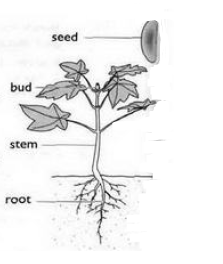
Stem (n- thân cây) is used as a verb to signify (v- báo hiệu) that something originates in something else:
_ Her discontent stems from (v- xuất phát từ) a traumatic experience she had last year.
A branch is something that grows off or branches out from a main organisation. So we talk about branches of a shop or a business branching out into new directions.
_ We haven't a blue sweater in your size, but you could try our Oxford Street branch.
Bud (flower befor it opens) is used in the expression nipped in the bud (stopped before it develops into something).
_ He's showing signs of neglecting (v- sao lãng) his work - we'd better nip that in the bud.
The adjective budding can also mean showing promise of future development:
_ She's a budding young actress.
2. Here are some metaphors based on verbs connected with plant growth and gardening.
_ The new boss is planning to weed out (v- rẩy cỏ, nhổ cỏ dại) older or less experienced staff. (get rid of)
_ The government will probably have to prune (v- tỉa, xén) back its proposals. (cut/limit)
_ At last she is reaping (v- thu hoạch) the reward of all her years of study. (is getting results from)
_ The journalists have dug up some interesting facts. (have discovered)
_ The idea was germinating while we were on holiday. (was beginning to develop)
_ Out-of-town shopping centres have been sprouting all over the country. (have been appearing quickly in large numbers)
_ Our business is flourishing. (is doing very well)
_ A deciduous tree sheds its leaves. (loses)
_ People can shed (v- bỏ rơi, để rơi) employees/traditions/worries/inhibitions/weight
_ Plants fade, wither, shrivel and wilt when they die, Theses verbs can all be used metaphorically:
Hopes of finding survivors are fading. (becoming smaller)
High inflation means that our savings are shrivelling. (becoming less)
It was so hot in the classroom that the students were starting to visit. (lose energy)
A glance/look/remark can wither or be withering. (make the recipient feel scorned)
She gave him a withering look.
_ Alec has spent most of his life in London, but he is keen to go back to his roots when he retires.
_ The business is firmly rooted in the west of England.
_ The idea took some time to take root but it;s very fashionable now.
_ His grandfather sowed (v- gieo) the seeds of the business's success.
_ The US bookshop chain is opening a number of branches in the UK.
_ It;s about time she put down some roots.
_ The idea for her novel stems/stemmed from her interest in mountain climbing.
_ The St Jame's Drama College turns out a hundred budding actors every year.
Read More ...
1. Buildings
Note how cement (n- xi măng) is used both to make buildings stronger and make relationships tronger.
_ It can be used in this way both as a noun and a verb:
Let's have a drink together to cement our partnership.
_ Brick wall used metaphorically means a barrier (n- chứng ngại vật):
When I tried to find out what had happened to my tax claim, I came up against a brick wall.
_ Ceiling can be used to suggest a limit to something:
They put a ceiling of twenty thousand pounds on the redundancy payments.
_ The glass ceiling is a phrase used to refer to an invisible barrier that stops people, especilly women, from rising to top position at work.
Roof as a metaphor:
_ The roof fell in on my world in the day he died.
Notice how the colloquial phrase go through the roof has two different meanings.
_ If prices go through the roof, they increase in a rapid, uncontrolled fashion.
_ If, however, a person goes through the roof, he or she loses their temper.
Hit the roof, similarly, can be used about prices but it is far more commonly used to mean lose one's temper:
_ The teacher will hit the roof when she sees the mess we've made of this work.
As a very tall building, tower conveys (v- chở, vận chuyển) an idea of distance from ordinary people. If someone lives in an ivory tower, he or she does not know about the unpleasant and ordinart things that happen in life:
_ Academics are often criticised for living in their ivory towers.
If a person is a tower of strength, they are extremely strong (in a emotinal rather than a physical sense):
_ Our friends were a tower of strength when our house burnt down,
If a person or thing towers above something or someone else, they are either outstandingly tall or outstanding in some other positive way:
_ Jack towers above all his classmates although he is actually one of the youngest pupils.
2. Entrances:
Gateway is used metaphorically in the phrase be a gateway to, meaning provide access, A degree in law is a gateway to a well-paid job.
Door can also be used in a similar way to gateway above, but it is also used in many other metaphorical phrases as well:
_ Failing his final exams closed/ shut a lot of doors for him.
_ Knowing several languages opens doors when it come to finding work.
_ The new century gives us the opportunity to close the door on our past and make a fresh start.
Doing something through/by the back door suggests doing it unofficially:
_ Joe came into the busines by the back door - the manager knew him from university.
Key can be used as a noun or an adjective to suggest the importance of something:
_ This research may provide/hold the key to developing a cure for cancer.
_ Knowing the right people is the key to success in that country.
_ The key figures in the government all went to the same universities.
As an adjective key collocates strongly with:

Complete these sentences by inserting the necessary verb:
_ The boss went through the roof when she saw Robert arriving late again.
_ We hope that this scientist's work may hold/provide the key to solving the problem.
_ A degree in economics opens the door to a number of interesting job opportunities.
_ Whenever you try to initiate something in this company you find that, sooner or later, you come up against a brick wall.
_ Jan's father hit the roof when he saw that she'd dyed her hair purple. (v- nhuộm)
_ Bill towers over all the other lawyers in his firm. He is by far the most able.
_ Her argument with the board last year has, unfortunately, shut/closed a lot of doors for her in this company.
_ The roof fell in on their world the day that war was declared. (v- tuyên bố, công bố)
_ My brother is always enormously supportive whenever I have a problem. (a tower of strength)
_ I would be relutant (adj- miễn cưỡng, ko tự nguyện) to work for a company that does a lot of business in an unofficial way. (through/by the back door)
_ The fee for this work will depend on the time it takes but cannot be more than twenty thousand dollars. (there is/ it has a ceiling of ...)
_ The cost of petrol has risen dramatically in the last six months. (has gone through the roof)
_ Having children often makes a marriage stronger. (cements a marriage)
_ Vancouver is the ideal place for starting to explore Western Canada. (the gateway to)
_ The most important decision we have to take now is where to locate our business. (key)
_ The professor has spent all his life in one university or another and really finds it very difficult to cope in the real world. (in an ivory tower)
_ The company has been locked in a legal battle for several years now. (involved in)
_ The speaker's request for questions was met with a wall of silence. (total silence)
_ Working on this project together should help to lay the foundations for a good relationship in the future. (provide the starting point)
_ Her eyes were locked on mine as she told me she was planning to go abroad. (firmly fixed on)
_ When Jack returned to this country he found his marriage in ruins. (n- sử đổ nát, phá sản) (had completely broken down)
_ This government should clean up its own back yard before criticising other countries. (put things right in its own immediate sphere of influence/ close to home)
Read More ...
1. Weather conversations
Here are some more unusual but still useful words about weather so that you can have typical weather conversations where you agree with someone by using a synonym.
In these examples B replies using more informal language.
A. Bit chilly, today, isn't it?
B. Yes, it's freezing/nippy, isn't it?
A. It's hot, isn't it?
B. Yes, it's boiling/sweltering/roasting!
A. It's a bit windy today!
B. Yes, really blowy/breezy, isn't it?
A. What oppressive/sultry weather!
B. Yes, isn't it stifling/heavy/close?
A. What a downpour/deluge!
B. Yes, it's chucking it down/ it's pouring!
A. Isn't it humid today? (adj- ẩm ướt)
B. Yes, horribly muggy/clammy.
2. Climate and metaphors (ẩn dụ)
Climate and metaphors are often used, particularly in written English. The word climate can refer to the general atmosphere or situation in society.
_ His dishonest policies towards the workers created a climate of distrust.
_ The goverment reforms (n- sữa đổi, cải cách) have created a climate of change.
_ The words, cultural, current, economic, financial, moral (đạo đức, tinh thần), political, social and prevailing all collocate (v- sắp xếp theo thứ tự) strongly with climate in this social sense.
_ She has a very sunny disposition - she's hardly ever miserable. (adj- cực khổ)
_ Job prospects are sunny.
_ Unfortunately, our plans met with a frosty reception. (tiếp nhận lãnh đạm)
_ 'You lied to me, didn't you?' she said icily. (adv- lạnh lùng)
_ I'm snowed under with work - I'll never get through it all in time.
_ After the company account were examined, the manager left under a cloud of suspicion (n- sự nghi ngờ).
_ Don't let your love for him cloud your judgement.
_ The soldires were hit with a hail (n- mưa đá) of bullets.
_ The Prime Minister was greeted with a hail/storm of abuse. (n- lăng mạ, chữi rủa)
_ After the long flight I was in a haze for a day or two.
_ I've only a hazy idea what you mean.
_ The truth is hidden in the mists of history. (n- mù sương)
_ She looked at him misty-eyed (adj- ủy mị, sướt mướt) - clearly in love
_ The article sparked off (v- khuấy động) a whirlwind of speculation. (cơn lốc tích trữ)
_ They had a whirlwind romance.
_ The horses thundered down the race track.
_ Thunderous applause (sự tán thưởng) followed his speech.
(Note: that thundery is used to describe stormy weather while thunderous describes a loud noise)
_ The winds of change/discontent/democracy (nền dân chủ) are blowing across the country.
sunny: pleasant and positive
frosty: coldness
icily: coldness, inhospitableness
snowed under: covered with a great amount of something
whirlwind: rapid, moving quickly
hail; lots of hard things that one can't stop or escape from
under a cloud: not bright and cheerful, something hidden
in a haze: lack of clearness
to thunder: loud deep noise
1. Climate
_ On a journey from north to south across this huge region, you would pass through a fascinating series of hot tropic landscapes. Plenty of rain falls in the far south, whereas the arid (1) northerly region is prone to (2) serious drought (3). (West Africa)
(1) dry
(2) tending to have a particular negative characteristic
(3) period without rain
2. Vegetation
_ About one third of the landscape of Canada lies within the Arctic Circle and can remain frozen for up to nice months of the year.
_ In these cold areas, known as the tundra (1), and vegetation (2) is limited. However, further south, large areas of land and covered by dense, coniferous (3) forests, known as taiga. Towards the border with the USA lie the mixed, temperate forests and the grasslands of the prairies (4). (Canada)
(1) area in north with no trees and permanently frozen ground.
(2) plant life
(3) trees that are avergreen (green all year round) and produce cones, unlike deciduous trees, which lose their leaves in winter.
(4) flat grassland in Canada and northrn USA (similar to steppes in Asia or pampas in South America)
3. Agriculture (nông nghiệp)
_ In the south the main crop is rice, though tea, cotton, fruit and vegetables are also grown.
_ The rice is planted in flooded paddy fields (1). Two crops of rice and one of vegetables are harvested in a good year.
_ In the north and west, which is drier and hillier, farmers grow a single crop of cereals (2) and tend (3) sheep and cattle. (China)
(1) fields planted with rice growing in water
(2) type of grass cultivated to produce a grain, i.e. a food plant like rice, wheat or maize
(3) take care of animals
4. Industry
_ One of the worlds's leading industrial nations, France has large manufacturing (1), steel and chemical industries and stand at the forefront (2) of engineering and technology.
_ The country is a major producer of cars and aircraft.
_ France has a large nuclear industry which generate (3) about 75 per cent of the country's electrical power. (France)
(1) producing goods in large numbers
(2) in an important position
(3) produces
5. Population
_ The population of Brazil is a mixture of people. Some are descended from (1) (v- có ai là tổ tiên) native Indians who have always lived in Brazil, other from the Portuguese who ruled (v- thống trị, cầm quyền) there for 300 years.
_ Many Brazillians have African ancestors (n- ông bà, tổ tiên) (2) who were brought over in the 17th century to work as slaves on sugar plantations. (n- đồn điền, khu đất trồng)
_ During the 20th century large numbers of European migrants (3) settled (4) in the south. (Brazil)
(1) are related to
(2) relatives from earlier times: we are our ancestor's descendants
(3) people who move to live in another country (an amigrant is someone who leaves a country and an immigrant is someone which moves to live in a country)
(4) made their homes.
plantation: tea, coffee, rubber
industry: maufacturing, pharmaceutical, textile
forest: deciduous, rain, dense
field: oil, wheat, ripe (ready to harvest)
nation: civilised, independent, sovereign
_ I believe my ancestors came to Britain from France in the 17th century.
_ Many emigrants left Russia for France after the Revolution in 1917.
_ The USA has traditionally welcomed immigrants/migrants from all over the world.
_ Our lasgest cities are full of migrants/immigrants looking for work and a better life.
_ Some Scots are said to be the descendants of 16th century Spanish sailors ship-wrecked off the Scottish coast.
_ About 80% of population lives in or around cities along the coast where life is easier than in the remote towns and farms of the outback (vùng xa xôi hẻo lánh). (Australia)
_ 400 years ago it was the centre of the Inca Empire that stretched (v- căng ra, kéo dài) the length of South America. (Peru)
_ Two thirds of the farmland (đất làm farm) is under water but deliberately (adv- có chủ tâm) so, because the fields are flooded to grow rice. (Vietnam)
_ To the east of a long, narrow peninsula more than a hundred islands make up the rest of the country. (Denmark)
_ Much of the land is desert, dotted with oases, but parts of the coastline (n- bờ biển) are more fertile (adj- phi nhiêu, màu mỡ). (Oman)
_ A line of volcanoes, many still active, dominates the landscape of this small country and forests, once rich with cedar, mahogany and oak, have been cut down for farmland. (El Salvador)
1. Booking travel and holidays
Here are some choices you may make when booking travel/holidays:
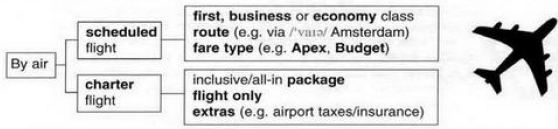
_ A scheduled flight is a normal, regular flight.
_ A charter flight is a special flight taking a group of people, usually to the same holiday destination.
_ Apex fares normally have to be booked a fixed number of days in advance and they offer value for money.
_ Budget fares are usually cheaper but may have restrictions (e.g. you can only travel on certain days) and are usually non-refundable or if you cancel, you may have to pay a cancellation fee.
_ Some tickets allow a stopover (you may stay somewhere overnight before continuing to your destination).
_ All-in packages normally include accommodation and transfers (e.g. a bus or coach to and from your hotel).
_ Sea travel is normally on a ferry, and the journey is called a crossing but you can have a holiday on the sea if you go on a cruise.
_ For some people a luxury cruise is the holiday of a lifetime (one you will always remember)
_ You may decide to book a berth in a shared cabin (a bed in a cabin with other people), or to have a single or double cabin.
_ For more money, you can often get a deluxe cabin, perhaps on the upper deck (the higher part of the ship, which is often bigger and more comfortable).
_ Cruises often go to exotic (unusual or exciting) islans where you can get away from it all (escape your daily life and routines)
_ Car hire is another way of getting around (informal: travelling to different places).
_ When you book it, you normally choose whether you want unlimited mileage (you can travel as many miles as you like for the same price).
_ There may also be extras to pay such as accident insurance.
_ If you hire a car it gives you the freedom to go as you please.
2. Accommodation
_ Some people prefer hotels. Others prefer self-catering (where you do your own cooking) accommodation,such as a holiday apartment or chalet (small cottage or cabin specially built for holiday-makers).
_ In Britain and Ireland, guest houses (private homes offering high standard accommodation; usually beautiful old building) offer good accommodation which is often cheaper than hotels, and there are many private homes offering bed-and-breakfast (often callled B and B).
_ Some types of accommodation offer half board (usually breakfast and one other meal) or full board (all meals)
_ It was a regular flight which the airline runs every day. (a scheduled flight)
_ I hate those special flights where everyone is booked to the same holiday destination. (a charter flight)
_ It was a ticket you had to book 30 days in advance to get the cheaper fare. (an Apex ticket)
_ The ticket allowed us to spend up to three nights in Singapore on the journey from London to Sydney. (a three-night stopover in Singapore)
_ You can get a bed on the ferry in a little room with three other beds. (a shared cabin)
_ We hired a car, with as many miles as we wanted free. (a car with unlimited mileage)
_ When you get there, the bus or taxi to your hotel is included in the cost of the holiday. (the transfers are included in the cost of holiday)
_ It was a special cheap fare, but there were some things you were not allowed to do. (it was a budget fare, but therer were restrictions)
Give expression to explain more than one type of holiday:
1. self-catering holiday: to be your own boss
2. camping trip: to rough it (i.e. to live in very basic conditions, without any extra comforts), to be out in the wilds (i.e. away from civilisation), to sleep under the starts (i.e. out in the open, without a roof over your head)
3. staying in an inn or a guest house; a cosy atmosphere (adj- ấm cúng, dễ chịu).
4. skiing holiday: an exhilarating experience, perhaps also a real learning experience.
5. cruise: to lounge around (sit or lie and relax for long periods), to just drift along.
6. sightseeing holiday: to spend a fortune on entrance fees, a real learning experience.
7. holiday with car hire: to go as you please, to just drift along, to keep on the move.
Read More ...
