Showing posts with label Metaphors. Show all posts
| 0 comments ]

1. Here are some metaphors based on parts of trees and plants
Seed(s) (hạt giống): is often used to talk about start of an idea or feeling:
_ the seeds of success, the seed of discontent, the seeds of revolution.

Root(s): is used suggest the origins of something. You can talk about going back to your roots, for example, meaning going back to the place where your family came from. You can also talk about the root of a problem or the roots of a tradition.

Putting down roots means settling down and making your home in one place:
_ After travelling the world for a couple of years, I was ready to go home and put down some roots.
_ When an idea becomes known or accepted, it can be said to take root.

Deeply and firmly collocate with rooted as in, for example;
_ Its origins are firmly/deeply rooted in the nineteeth century.
_ The grass roots of an organisation or society are the ordinary people in it, not the leaders.
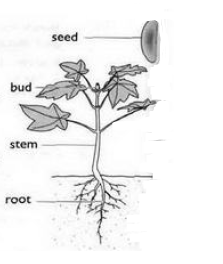


Stem (n- thân cây) is used as a verb to signify (v- báo hiệu) that something originates in something else:
_ Her discontent stems from (v- xuất phát từ) a traumatic experience she had last year.

A branch is something that grows off or branches out from a main organisation. So we talk about branches of a shop or a business branching out into new directions.
_ We haven't a blue sweater in your size, but you could try our Oxford Street branch.

Bud (flower befor it opens) is used in the expression nipped in the bud (stopped before it develops into something).
_ He's showing signs of neglecting (v- sao lãng) his work - we'd better nip that in the bud.
The adjective budding can also mean showing promise of future development:
_ She's a budding young actress.

2. Here are some metaphors based on verbs connected with plant growth and gardening.
_ The new boss is planning to weed out (v- rẩy cỏ, nhổ cỏ dại) older or less experienced staff. (get rid of)
_ The government will probably have to prune (v- tỉa, xén) back its proposals. (cut/limit)
_ At last she is reaping (v- thu hoạch) the reward of all her years of study. (is getting results from)
_ The journalists have dug up some interesting facts. (have discovered)
_ The idea was germinating while we were on holiday. (was beginning to develop)
_ Out-of-town shopping centres have been sprouting all over the country. (have been appearing quickly in large numbers)
_ Our business is flourishing. (is doing very well)
_ A deciduous tree sheds its leaves. (loses)
_ People can shed (v- bỏ rơi, để rơi) employees/traditions/worries/inhibitions/weight
_ Plants fade, wither, shrivel and wilt when they die, Theses verbs can all be used metaphorically:
Hopes of finding survivors are fading. (becoming smaller)
High inflation means that our savings are shrivelling. (becoming less)
It was so hot in the classroom that the students were starting to visit. (lose energy)
A glance/look/remark can wither or be withering. (make the recipient feel scorned)
She gave him a withering look.

_ Alec has spent most of his life in London, but he is keen to go back to his roots when he retires.
_ The business is firmly rooted in the west of England.
_ The idea took some time to take root but it;s very fashionable now.
_ His grandfather sowed (v- gieo) the seeds of the business's success.
_ The US bookshop chain is opening a number of branches in the UK.
_ It;s about time she put down some roots.
_ The idea for her novel stems/stemmed from her interest in mountain climbing.
_ The St Jame's Drama College turns out a hundred budding actors every year.

Read More ...
| 0 comments ]

1. Buildings
Note how cement (n- xi măng) is used both to make buildings stronger and make relationships tronger.
_ It can be used in this way both as a noun and a verb:
Let's have a drink together to cement our partnership.
_ Brick wall used metaphorically means a barrier (n- chứng ngại vật):
When I tried to find out what had happened to my tax claim, I came up against a brick wall.
_ Ceiling can be used to suggest a limit to something:
They put a ceiling of twenty thousand pounds on the redundancy payments.
_ The glass ceiling is a phrase used to refer to an  invisible barrier that stops people, especilly women, from rising to top position at work.
Roof as a metaphor:
_ The roof fell in on my world in the day he died.
Notice how the colloquial phrase go through the roof has two different meanings.
_ If prices go through the roof, they increase in a rapid, uncontrolled fashion.
_ If, however, a person goes through the roof, he or she loses their temper.
Hit the roof, similarly, can be used about prices but it is far more commonly used to mean lose one's temper:
_ The teacher will hit the roof when she sees the mess we've made of this work.
As a very tall building, tower conveys (v- chở, vận chuyển) an idea of distance from ordinary people. If someone lives in an ivory tower, he or she does not know about the unpleasant and ordinart things that happen in life:
_ Academics are often criticised for living in their ivory towers.
If a person is a tower of strength, they are extremely strong (in a emotinal rather than a physical sense):
_ Our friends were a tower of strength when our house burnt down,
If a person or thing towers above something or someone else, they are either outstandingly tall or outstanding in some other positive way:
_ Jack towers above all his classmates although he is actually one of the youngest pupils.

2. Entrances:
Gateway is used metaphorically in the phrase be a gateway to, meaning provide access, A degree in law is a gateway to a well-paid job.

Door can also be used in a similar way to gateway above, but it is also used in many other metaphorical phrases as well:
_ Failing his final exams closed/ shut a lot of doors for him.
_ Knowing several languages opens doors when it come to finding work.
_ The new century gives us the opportunity to close the door on our past and make a fresh start.
Doing something through/by the back door suggests doing it unofficially:
_ Joe came into the busines by the back door - the manager knew him from university.

Key can be used as a noun or an adjective to suggest the importance of something:
_ This research may provide/hold the key to developing a cure for cancer.
_ Knowing the right people is the key to success in that country.
_ The key figures in the government all went to the same universities.
As an adjective key collocates strongly with:


Complete these sentences by inserting the necessary verb:
_ The boss went through the roof when she saw Robert arriving late again.
_ We hope that this scientist's work may hold/provide the key to solving the problem.
_ A degree in economics opens the door to a number of interesting job opportunities.
_ Whenever you try to initiate something in this company you find that, sooner or later, you come up against a brick wall.
_ Jan's father hit the roof when he saw that she'd dyed her hair purple. (v- nhuộm)
_ Bill towers over all the other lawyers in his firm. He is by far the most able.
_ Her argument with the board last year has, unfortunately, shut/closed a lot of doors for her in this company.
_ The roof fell in on their world the day that war was declared. (v- tuyên bố, công bố)

_ My brother is always enormously supportive whenever I have a problem. (a tower of strength)
_ I would be relutant (adj- miễn cưỡng, ko tự nguyện) to work for a company that does a lot of business in an unofficial way. (through/by the back door)
_ The fee for this work will depend on the time it takes but cannot be more than twenty thousand dollars. (there is/ it has a ceiling of ...)
_ The cost of petrol has risen dramatically in the last six months. (has gone through the roof)
_ Having children often makes a marriage stronger. (cements a marriage)
_ Vancouver is the ideal place for starting to explore Western Canada. (the gateway to)
_ The most important decision we have to take now is where to locate our business. (key)
_ The professor has spent all his life in one university or another and really finds it very difficult to cope in the real world. (in an ivory tower)

_ The company has been locked in a legal battle for several years now. (involved in)
_ The speaker's request for questions was met with a wall of silence. (total silence)
_ Working on this project together should help to lay the foundations for a good relationship in the future. (provide the starting point)
_ Her eyes were locked on mine as she told me she was planning to go abroad. (firmly fixed on)
_ When Jack returned to this country he found his marriage in ruins. (n- sử đổ nát, phá sản) (had completely broken down)
_ This government should clean up its own back yard before criticising other countries. (put things right in its own immediate sphere of influence/ close to home)


Read More ...

About