Showing posts with label Expressions. Show all posts
| 0 comments ]

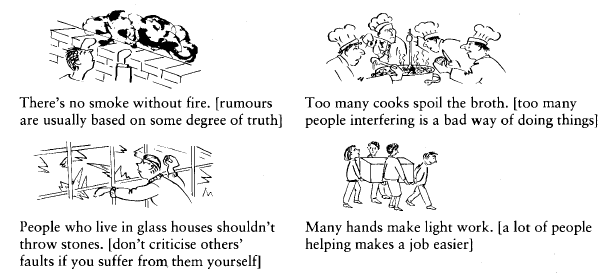
Speakers tend to use proverbs to comment on a situation, often at the end of a true story someone has told, or in response to some event. As with all idiomatic expressions, they are useful and enjoyable to know and understand, but should be used with care.

1. Warnings/ advice/ morals - do's and don'ts


2. Key elements
Proverbs can also be grouped by some key elements, for example, animals and birds
_ When the cat's away, the mice will play. (people will take advantage of someone else's absence to behave more freely)
_ You can lead a horse to water but you can't make it drink. (you can try to persuade someone, but you can't force them)
_ One swallow (n- ngum nuoc) doesn't make a summer. (one positive sign does not mean all will be well)

3. Visualising
As with learning all vocabulary, visualising some element often helps.


Read More ...
| 0 comments ]

1. As ... as ... similes are easy to understand
If you see the phrase as dead as a doornail, you don't need to know what a doornail is, simply that the whole phrase means 'totally dead'.
Creating a picture in your mind can often help you remember the simile (n- sự so sánh):


as blind (adj- đui mù) as bat
as thin as a rake
as strong as an ox
as quiet as a mouse

Some other useful as ... as ... phrases.
_ The bed was as hard as iron and I couldn't sleep.
_ I'll give this plant some water. The soil's as dry as a bone.
_ He's as mad as hatter. He crossed the Atlantic in a bathtub.
_ She told the teacher, as bold as brass, that his lessons were boring.
_ You'll have to speak up (v- nói lớn) ; he's as deaf (adj- điếc) as a post (n- trụ, cột).
_ Don't worry. Using the computer's as easy as falling off a log.
_ She knew the answer as quick as a flash.
_ When I told him, his face went as red as a beetroot (n- củ cải đường).

Sometimes the second part can change the meaning of the first.
_ The Princes's skin was as white as snow. (beautifully white)
_ When he saw it, his face went as white as a sheet. (pale with fear/horror)
_ The fish was bad and I was as sick as a dog. (vomitting)
_ She ran off with my money; I felt as sick as a parrot. (bad feeling of disillusionment/ frustration)

2. Like ...
_ My plan worked like a dream, and the problem was soon solved.
_ Be careful the boss doesn't see you; she has eyes like a hawk (n- diều hâu).
_ No wonder he's fat. He eats like a horse and drinks like a fish.
_ Did you sleep well? Yes, thanks, like a log.
_ Sorry, I forgot to ring him again. I've got a head like a sieve!
_ The boss is like a bear with a sore head today. (in a very bad temper)
_ She goes around like a bull in a china shop.

Read More ...
| 0 comments ]

1. Conversation-building expressions
These are some common expressions that help to modify or organise what we are saying.
There are many more expressions like these.
Expression (meaning/function)
_ As I was saying. I haven't seen her for years. (takes the conversation back to an earlier point)
_ As I/you say, we'll have to get there early to get a seat. (repeats and confirms something someone has already said).
_ Talking of skiing, whatever happend to Bill Jakes? (starting a new topic but linking it to the present one)
_ If you ask me, she's heading for trouble. (if you want my opinion)
_ That reminds me, I haven't rung George yet. (S.T in the conversation reminds you of S.T important)
_ Come to think of it, did he give me his number after all? I think he may have forgotten. (S.T in the conversation makes you realize there may be a problem/query about S.T)

2. Key words
Some everyday expression can be grouped around key words.
This and that:
_ This is an important point.
_ That's the last thing, we've finished.
_ We talked about this and that or the other.
_ That is agreed, settled (adj- chắc chắn), finalized.

3. Common expressions for modifying statements
(refer to document)
_ Come to think of it, I don't remember giving her the key. I'd better ring her and check, just in case.

Read More ...
| 0 comments ]

Our basic five senses are sight, hearing, taste, touch and smell. What is sometimes referred to as a 'sixth sense' is a power to be aware of things independently of the five physical senses, a kind of supernatural sense. The five basic verbs refering to the senses are modified by an adjective rather than an adverb.
_ He looks dreadful (adj- dễ sợ, khiếp).
_ The trip sounds marvellous (adj- kỳ diệu, phi thường).
_ The cake tastes good.
_ It felt strange.
_ The soup smelt delicious.

1. Sight
Look at the verbs of seeing in the text below.
_ Yesterday I glanced (v- liếc nhìn) out of the window and noticed a man observing a house opposite through a telescope (n- kính thiên văn).
_ I thought I glimpsed (v- thoáng thấy) a woman inside the house.
_ Then I saw someone else peering into (v- nhòm, ngó) the window of the same house.
_ I gazed at (v- nhìn chằm chằm) them wondering what they were doing.
_ Suddenly the first man stopped staring (adj- nhìn chằm chằm) through his telescope.
_ He went and hit the other one on the head with the telescope and I realized that I had witnessed (v- chứng kiến) a crime.

2. Hearing
The following scale relates to the sense of hearing and how loud things are:
   noiseless (ko có tiếng ồn)
   silent
   quiet
   noisy
   loud
   deafening (adj- làm điếc, inh tai)

3. Taste
Some different tastes with an example of a typical food.
   sweet (honey) (adj- ngọt) (pineapple n- quả thơm)
   salty (crisps) (adj- mặn)
   bitter (strong coffee) (adj- đắng) (unsweetened coffee n- cafe ko bỏ đường)
   sour (vinegar) (adj- vị chua) (lime n- chanh)
   spicy (Indian food) (adj- có mùi gia vị)
   hot (chilli)
If you say something tastes hot it may mean spicy rather than not cold.
Food can be tasty (adj- đầy hương vị), but tasteful (adj- trang nhã, có thẩm mỹ) is used to refer to furnishings, architecture or a style of dressing or behaviour.
The opposite of both is tasteless.

4. Touch
Some good verbs for describing different ways of touching
_ She nervously fingered (v- sờ mó)  her collar (n- cổ áo).
_ She tapped (v- vỗ nhẹ, gõ nhẹ) him on the shoulder
_ She grabbed (v- vồ lấy, gật lấy) her bag and ran.
_ He stroked (v- vuốt, vuốt ve) the cat and patted (v- vỗ nhẹ, vỗ về) the dog.
_ He grasped (v- nắm chặt, túm chặt) my hand and we ran.
_ It's rude to snatch (v- nắm lấy).
_ Press the button.
_ Please handle (v- cầm; xử lý) the goods with great care.
_ The secretaries complained the their boss was always pawing (v- sờ soạng) them. (an offensive (adj- khó chịu) way)

5. Smell
These adjectives describe how something smells.
   stinking (adj- rất khó chịu)
   evil-smelling
   smelly (adj- nặng mùi, hôi, thối)
   aromatic (adj- thơm)
   scented (adj- có mùi thơm nước hoa)
   fragrant (adj- thơm phức)
   sweet-smelling (adj- thơm)
   perfumed (adj- có xức nước hoa)

6. Sixth sense
Different phenomena (hiện tượng) which a person with sixth sense may experience:
   telepathy (n- ngoại cảm): suddenly think of someone two munites before they phone you?
   ghosts: see someone in white disappering into a wall?
   UFOs: see a flying saucer?
   premonitions (n- linh cảm): refuse to travel on plane because you feel something bad is going to happen?
   intuition (n- trực giác)

_ That smells wonderful
_Your hair looks great.
_ It sounds brilliant
_ This tastes delicious
_ I feel great
_ That sounds fantastic
_ You look upset. What's the matter?
_ He smells disgusting (adj- kinh tởm).

Read More ...
| 0 comments ]

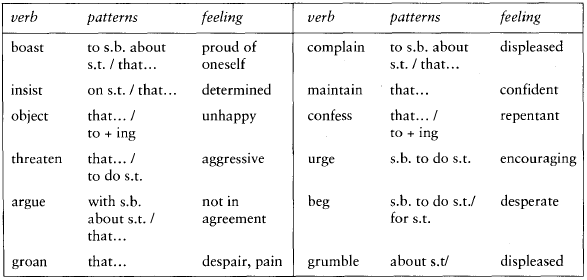
The verbs in the table below describe how loudly or quietly a person is speaking and also, often, indicate mood. These verbs are all followed by clauses beginning with "that".


The following verbs all indicate something about how the speaker feels. What they usually indicate is given in the feeling column.


Some useful adverbs describing the way someone is feeling while they are speaking.
_ If someone feels angry: angrily, crossly, furiously, bitterly
_ If someone feels unhappy: unhappily, gloomily, miserably, uneasily, sadly.
_ If someone feels happy: happily, cheerfully, gladly, hopefully, eagerly (hăng hái, ham muốn)
_ If someone feels worried: anxiously, nervously, desperately (liều lĩnh), hopelessly.

Other useful adverbs are boldly, excitedly, gratefully, impatiently, passionately, reluctantly, shyly, sincerely.


Read More ...
| 0 comments ]

1. Happiness and unhappiness
You feel:
_ ecstatic (adj- mê ly, sung sướng): when you are madly (adv- điên cuồng, liều lĩnh) in love or are spirituallly uplifted (tâm hồn bay bổng) for some reason.
_ content(ed) (adj- bằng lòng, toại nguyện): when you are peaceful and satisfied with what you have. Notice that content is not used before a noun. You can say 'She is content' or 'She is contented' but only 'a contented person'.
_ cheerful: when life is looking quite bright and positive.
_ grateful: when someone has done you a favour (n- thiện ý, quý mến).
_ delighted: when something has happened that gives you great pleasure, when you hear news of someone's good fortune, for instance.
_ miserable: when everything seems wrong in your life.
_ discontented: when your life is not giving you satisfaction.
_ fed-up/ sick and tired: when you have had enough of something disagreeable. You could be fed up with someone's rudeness (n- sự khiếm nhã, bất lịch sự), for instance, or sick and tired of someone's behaviour.
_ depressed (adj- chán nản, phiền muộn): when you are miserable over a long period of time. Depression is considered an illness in some severe (adj- nghiem khắc) cases.
_ frustrated (adj- thất vọng): when you are unable to do something that you want to do.
_ confused / mixed up: when you cannot make sense of different conflicting (adj- xung đột, đối lập, mâu thuẫn) feelings or ideas; mixed up is more colloquial (adj- thông tục).

2. Excitement, anger and anxiety
You feel:
_ excited: when you are expecting special to happen, e.g. before a party or before a meeting with someone special.
_ inspired (adj- đầy năng lực sáng tạo): when you are stimulated to creative deeds or words. You might feel inspired after listening to some very powerful music, perhaps, or you might be inspired to action by a friend.
_ enthusiastic (adj- nhiệt tình, hăng hái): when you have very positive feelings about something, e.g. a new project.
_ thrilled (adj- hồi hộp, ly kỳ): when something extremely exciting and pleasing happens - quite a colloquial word. She was thrilled when the film star kissed her.
_ cross (adj- bực mình, cấu gắt): when you angry or bad-tempered. It is often, though not exclusively, used about small children.
_ furious (adj- giận dữ, điên tiết)/livid/ seething: when you are extremely angry.
_ anxious: when you are afraid and uncertain about the future. I am so anxious about the results of my exams that I can't sleep.
_ nervous: when you are afraid or anxious about something that is about to or may be about to happen. I always feel nervous when I have to go the dentist.
(Feeling nervous is a little bit like feeling excitied but it is a negative feeling whereas excitement is positive)
_ apprehensive (adj- sợ hãi, e sợ): when you are slightly nervous or anxious about something in the future.
_ worried: when anxious thoughts are constantly going through your head.
_ upset (adj- bối rối, lo lăng, đau khổ): when something unpleasant has happened to disturb you. It often combines feelings of both sadness and anger.


_ I didn't know who was telling the truth. I felt totally confused.
_ Some mothers are depressed for several months after the birth of a baby.
_ I think she is bad-tempered because she is frustrated. She wanted to be an actress and not a school teacher.
_ Although he seems to have everything anyone could possibly want, he is till discontented.
_ He went skiing for the first time last month, but now he is so enthusiastic about it that he can talk of little else.
_ My baby brother gets very cross by the evening if he doen't have an afternoon sleep.
_ This rainy weather has gone on for so long. I feel really fed-up with it.
_ He was terribly upset when he heard the news of his friend's accident.
_ She was thrilled when she learnt that she had won the first prize.

_ I felt anxious until we heard the results of mother's medical tests.
_ I felt slightly apprehensive before my first trip to China.
_ I was very grateful to him for lending me his car.
_ I was in a terrible rage when I heard about the unkind things the teacher had said to my best friend.
_ I was miserable for days when I broke up with my boyfriend.
_ I was so inspired by the book, 'The Story of San Michele', that I decided I would become a doctor too.
_ I was initially very enthusiastic about skating but I soon lost interest.

Read More ...
| 0 comments ]

1. Verbs connected with beliefs and opinions
You probably already know think and believe; here are more
_ I'm convinced (v- nhận thấy) we've met before.
_ I've always held (hold v- giữ) that compulsory education is a waste of time.
_ She maintains that we're related, but I'm not convinced.
_ I feel she shouldn't be forced to do the job.
_ I reckon (v- tìm ra) they'll get married soon.
_ I doubt we'll ever see total world peace.
_ I suspect (doubt) a lot of people never even think about pollution when they're driving their own car.

Prepositions used with belief and opinion words
_ Do you believe in God?
_ What are your views on divorce?
_ What do you think of the new boss?
_ I have my doubts about this plan.
_ I have strong views on marriage.
_ Most people believe in life after death.
_ I was in favour of the proposed changes.
_ What does she think of the new teacher?
_ This is absurd (adj- vô lý, ngớ ngẩn) from our point of view.
_ He's quite wrong in my opinion.
_ Well, that's just sillu, to my mind,

Describing the beliefs and views of these people, as in the example:
_ A person who insists (v- khăng khăng) that the earch is flat (mặt phẳng). (An eccentric (adj- lập dị, kỳ cục) belief)
_ A person who believes absolutely in the power of love to solve world problems. (A firm/strong believer in the power of love)
_ A socialist neither (ko ca) on the left or the right of party. (A moderate (adj-ôn hòa, vừa phải) /middle-of-the-road socialist)
_ A vegetarian who refuses even to be in the same room as people who like meat. (A fanatical/obsessive vegerarian)
_ Someone who is always suspicious of change. (A rather conservative/traditional view of the world)

Read More ...
| 0 comments ]

1. Succeeding
_ I managed to contact him just before he left his office.
_ I don't think I can manage the whole walk. I think I'll turn back.
_ We succeeded in persuading a lot of people to join our project.
_ We've achieved/ accomplished (v- hoàn thành) a great deal in the last three years.
_ The company has achieved all its goals/aims/targets for this year.
_ Do you think his plan with come off? (v- dc hoan thanh)

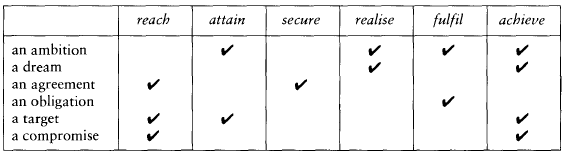
Matrix for some typical collocations with 'succeeding' verbs:


_ The management have reached/secured an agreement with the union (n- công đoàn) which will guarantee no strikes for the next three years.
_ Now that I've fulfilled all my responsibilities to my family, I feel I can retire and go round the world.
_ The church building-fund has failed to reach/attain/achieve its target of $250,000.
_ I never thought I would attain/realize/fulfill my ambition (n- muon mong, tham vong), but now I have.
_ Very few people realize/fulfill all their hopes and dreams in life, very few indeed, I cal tell you.
_ We hope the two sides reach/achieve a compromise and avoid war.
_ I'm afraid that little scheme of mine didn't come off.

2. Failing
_ Plans and projects often go wrong or misfire (v- ko nỗ). (don't turn out as intended)
_ Companies, clubs and societies often fold throuhg lack of success. (close down)
_ A plan or project may falter, even if it finally succeeds. (go through ups and down)
_ All your plans and hard work/efforts may come to nothing.

3. Difficulty
_ I have great difficulty in getting up in the morning. I find it difficult to remember the names of everybody in the class.
_ It's hard/difficult to hear what she's saying.
_ I often have trouble starting the car on cold mornings.
_ We've had a lot of bother (n- điều khó chịu) with the neighbours lately (adv- gần đây).
_ Can you cope with (v- đối phó, đương đầu) three more students? They've just arrived.
_ I've no money, my girl-friend's left me; I need help; I just can't cope any more.


Read More ...
| 0 comments ]

1. Possession - Ownership
_ All his possesions were destroyed in the terrible fire.
_ Don't leave any of your belongings here; we've had a few thefts recently.
Estate in the singular can mean a big area of private land and the buildings on it.
_ She owns a huge estate in Scotland. (land, etc.)
_ After his death, his estate was calculated at $3 million.
Property (uncountable) is used in a general sense for houses, land, etc.
_ He's only fourteen; he's too young to own propery.
_ A property (countable) is a building, e.g. house, office-block.
_ She's just bought at very nice property near the town-centre.

_ The proprietor (n- người chủ sở hữu) of this restaurant is a friend of mine.
_ The landlord/ lady's put the rent up. (owner of rented property)
_ Do you own this house? _ No we're just tenants (n- người thuê mướn).

2. Giving
_ The river provides the village with water. (or supplies)
_ Would you like to contribute/ donate something to the children's hospital fund (n- nguồn tài chính)?
_ Jakes Ltd. supplies our school with paper and other items.
_ It gives me pleasure to present (v- biếu, tặng) you with this clock from us all.
_ When I retired they presented me with a camcorder.
_ The school restaurant cater (v- cung cấp thực phẩm, phục vụ) for 500 people every day.
_ That uncle of mine that died left $3,000 to a dogs' home.
_ When she died she donated all her books to the library.
_ You've been allocated room 24. Here's your key.

3. Lending, etc
_ We've decided to hire/rent a car. Can you recommend a good car-hire/ car-rental firm?
_ We'd like to rent a flat in Oxford for six months.
_ We've hired the lecture-room for a day.
_ That step-ladder you lent me last week, could I brrow it agan?
_ I'm trying to get a loan from the bank to buy a boat.

Read More ...
| 0 comments ]

1. Obligation
Must is an instruction or command; that is why we see it on notices
   Dogs must be kept on a lead.
   Cars must not be parked here
Have (got) to says that cirumstances oblige (v- buộc) you to do something. Often, the two meanings overlap and there will be a choice of how to express the oblication, but not always.

_ The company is obliged to give a refund if the tour is cancelled.
_ You will be liable (adj- có bổ phận) to pay tax if you work.
_ The bank robbers forced (v- ép, áp đặt) him at gunpoint (n- chĩa súng) to open the safe.
_ We had no choice/alternative but to sell our house; we owed the bank $100,000
_ The death sentence is mandatory for drug-smuggling in some countries.
_ Was sport compulsory (adj- buộc, phổ cập)/ obligatory (adj- bắt buộc) at your school? No, it was optional at mine.
_ I am exempt (adj- được miễn) from tax as I'm a student. (free from obligation)

The negative of must and have (got) to are formed with need and have to, when we mean something is not necessary/ not obligatory.

_ They were losing $1 million a year, so the company was obliged/ forced to close down/ had to close down.
_ You don't have to buy travel insurance, it is optional.
_ You can hire a video camera, but you have to pay a deposit.
_ We'll have to sell the house, I'm afraid we have no choice/alternative (n), otherwise we'll go/be bankrupt (v- phá sản, vỡ nợ).
_ You're over 50, you're exempt from military service/ not obliged to do military service.

2. Scalse of probability: 'cannot happen' to 'has to happen'
impossible (adj- ko thể xẩy ra)
unlikely
possible
probable
certain
inevitable (adj- chắc chắn xẩy ra)

_ Most people usually suffer from a lack of time or of money.
_ Filling out a tax return is obligatory once a year in many countries.
_ Death is certainly inevitable for all of us.
_ A videophone in every home is quite possible by 2025.
_ Rain in the Amazon forest within eight days is highly likely!
_ A human being living to 250 is absolutely imposible.
_ Most people feel they are in need of more time and money, and millions of people in the world are in need of food and a decent home.
_ A third world war? Very possible if we continue to build nuclear weapons.

Read More ...
| 0 comments ]

1. Number and quantity
Number is used for countable nouns, amount for uncountable
Scale of adjectives useful for expressing number and quantity:


_ Add just a tiny amount of chilli pepper, or else it may get too hot.
_ A considerable number of people failed to get tickets. (formal)
_ Vast/huge amount of money have been wasted on this project.
_ Were there many people at the airport? Oh, about average, I'd say.

$5 bilion was wasted on the developing the new rocket.
_ That's a huge amount of money to be wasted like that!
Over 50 people come to Sally's lecture yesterday. We were pleasantly surprised.
_ That's a considerable number of people.
We have 120 students most years, and we'll probably have about that this year, too.
_ It seems it'll be about average again this year, then.
There was only five dollar in my purse when it was stolen
_ At least that's only a small amount of money.
We've wasted over 100 hours in meetings and got nowhere (adv- ko noi nao).
_ You've wasted a huge amount of time.

Much/many, a lot, lots, plenty, a good/great deal
   Is there much work to do?_ No, not much.
   There are lots of nice shops in this street.
   Don't worry, there's plenty of time.
   You were making a lot of noise last night.
   There's a great deal of hard work still to do.

I've got dozen of nails in my tool-box. Why buy more?
There's heaps/bags/loads of time yet, slow down!
There was absolutely tons of food at the party.
There are tons of apples on this tree this year.

2. Degree and intensity (cuong do)
Typical collocations of adverbs: a bit, quite, rather, fairly (adv- kha kha), very, really, awfully, extremely combine with 'scale' adjectives such as tired, worried, weak, hot.
Totally, absolutely, completely, utterly combine with 'limt' adjectives such as ruined, exhausted, destroyed, wrong.

_ You heard that a friend was in trouble with the police. (quite shocked/ extremely anxious)
_ A close friend coming to stay did not turn up and sent no message to say why. (slightly anxious/ a bit surprised)
_ Three people gave you different directions to get to the same place. (rather/quite/ totally confused)
_ You passed an exam you expected to fail. (quite surprised)
_ Your best friedn was going abroad for two years. (a bit / rather sad)
_ You had been working non-stop for 18 hours. (absolutelty/ completely exhausted/ extremely tired)

Read More ...
| 0 comments ]

Các bạn hãy tham khảo các trường hợp sau đây:

1. “both ... and ...” (cả ... lẫn, ... vừa ... vừa ...)
VD: Both Tom and Mary are students. Cả Tom và Mary đều là sinh viên.
                    (= Tom is a student and Mary is a student
                     = Tom and Mary are students.
                     = Tom is a student and so is Mary.
                     = Tom is a student and Mary is, too.

2. “not only ... but also ...” (chẳng những ... mà còn ...)
VD: Miss Tien is not only beautiful but also lovely. Cô Tiên chẳng những xinh đẹp mà còn dễ thương nữa. (= Miss Tien is both beautiful and lovely.)

3. “either” (mỗi ... trong số hai đối tượng)
VD: Either teacher has a laptop. Mỗi giáo viên có một cái máy tính xách tay. _ Hiểu một cách chính xác là: Có hai giáo viên, mỗi người có một cái máy tính xách tay.

= Both teachers have laptops = Each of the two teacher has a laptop.

4. “but” (nhưng) và “otherwise” (trái lại)
VD: Mr. David is friendly, but his wife isn't. Ông David thì thân thiện, nhưng vợ ổng thì không. = Mr. David is friendly otherwise his wife isn't.

5. “although” (mặc dù ... nhưng) và “despite”
VD: Although it rained heavily yesterday, he walked home without a raincoat.

= He walked home without a raincoat despite the heavy rain yesterday.

6. “so that” : (để mà) và “to_V” (trong mẫu câu chỉ mục đích)
VD: We eat so that we may live. Chúng ta ăn để sống. = We eat to live.

7. “enough” (đủ) và  “too ... to_V” (quá không thế)
VD: He isn't old enough to go to school. Nó chưa đủ tuổi đi học.

= he is too young to go to school.

8. “because” (bởi vì) và “so ... that” (đến nỗi mà ...)
VD: Bob can't lift up this suitcase because he is too weak. Bob không thể nhấc nổi cái va-li này vì anh ta quá yếu. =Bob is so weak that he can't lift up this suitcase.

9. “in”, “within”, “for” + thời gian (trong một khoảng thời gian) và “it takes” (phải mất...)
VD: I have finished repairing my motorbike in three hours. Tôi vừa sửa xong chiếc xe gắn máy trong ba tiếng đồng hồ. = It takes me three hours to repair my motorbike.

10. Thể khẳng định của so sánh nhất và thể phủ định của so sánh bằng.
VD: She is the best student in my class. Cô ấy là sinh viên giỏi nhất trong lớp tôi.

= No one is as good as her in my class.

11. Tính từ so sánh nhất và trạng từ so sánh hơn.
VD: He is the best football player that I have ever known. Anh ta là cầu thủ bóng đá giỏi nhất mà tôi từng biết. =He plays football better than those that I have ever known.

12. Danh từ và động từ.
VD: She is a very good cook. cô ấy là đầu bếp rất giỏi. = She can cook very well.

13. Tính từ và trạng từ.
VD: He is a careful driver. Ông ấy là một tài xế cẩn thận. = He drives carefully.

14. Hai danh từ đồng nghĩa.
VD: It took him two weeks to design a new fashion sample. Anh ta đã phải mất hai tuần để thiết kế một mẫu thời trang mới.

= It took him fortnight to design a new fashion sample. / “fortnight”: nữa tháng

15. “because” và “because of”
VD: Daisy went to school late yesterday because she got up late. hôm qua Daisy đi học trễ bởi vì cô ấy thức dậy trễ. = Daisy went to school late yesterday because of her getting up late.

        Khải didn't achieve his planned aims because he had made a serious mistake. Khải không đạt được mục tiêu đã định vì trước đó anh ta đã phạm một sai lầm nghiêm trọng. = Khải didn't achieve his planned aims because of his serious mistake.

Read More ...
| 0 comments ]

all (of) (tất cả)
each of (mỗi/một)
every one of (mỗi/một)
almost all (gần hết)
most (nhiều)
most of (phần lớn)
a great many of (rất nhiều)
a number of (nhiều)
a great number of (rất nhiều)
a lot of  (nhiều)
lots of  (nhiều)
a mount of (một lượng)
many (nhiều)
plenty of (nhiều)
quite a few (một số)
quite a lot of  (khá nhiều)
some of (một vài)
several of (nhiều)
a certain number of (một số lớn)
a few/little of (một vài)

Example:
I read all the e-mail messages in my inbox.
I read almost all the e-mail messages.
I read most of the e-mail messages.
I read lots of e-mail messages.
I read quite a lot of e-mail messages.
I read some of the e-mail messages.
I read a few of the e-mail messages.

not all (không phải tất cả)
not every (không phải mỗi/mọi)
not many/much of (không nhiều)
almost no (hầu như không có)
almost none of (hầu như không có)
hardly any of (hầu như không có)
no (không)
none of (không…trong số…)

Example:
Not all the e-mail messages were read.
Not every e-mail message was read.
Not many of the e-mail messages were read.
Few of the e-mail messages were read
I read almost no e-mail messages.

Either (pron): one or the other of two.
Neither (pron) not one nor the other of two things or person.

Example:
Neither answer is correct.
Neither of them has/have a car.
You can park on either side of the street.
Either is acceptable.

Read More ...

About